

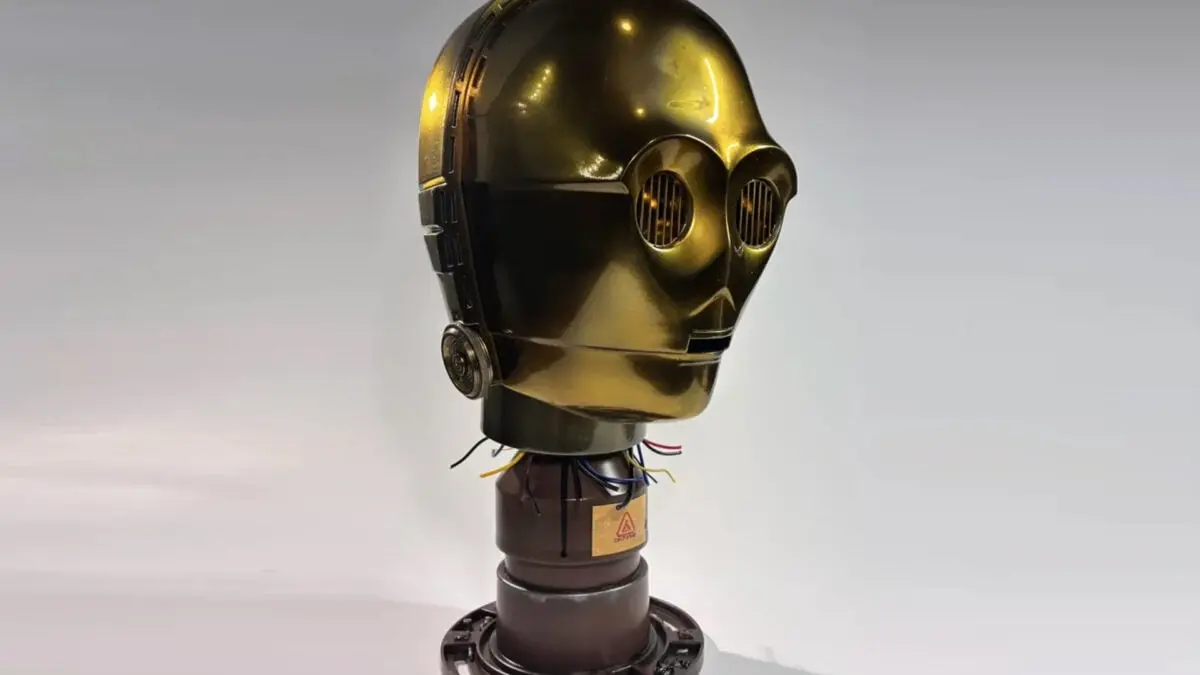
May the Fourth be with you, and all that. For Star Wars Day, we turn our attention to one of the galaxy far, far away's most iconic characters: C-3PO, the shiny golden droid whose personality mixes a maître d's haughty disdain with an endearing neuroticism. While fans often focus on R2-D2's adventurous beeps, Threepio provides the verbal commentary that makes the pair so memorable. Now, thanks to a brilliant DIY project, you can build a talking C-3PO head that actually converses—bringing you closer to the Star Wars universe than ever before.
The original head prop from The Empire Strikes Back made headlines last month when it sold at auction for over $1 million, joining the ranks of the most expensive Star Wars memorabilia ever sold. In the film, the head is famously separated from its body after Threepio wanders through the wrong door in Cloud City, delivering some of the saga's most comedic moments. But if that price tag put the dream of owning a C-3PO head out of reach, a student at Chapman University in Orange County, California, has offered a far more accessible alternative: a do-it-yourself version that not only sits on your coffee table but also talks to you.
The Brains Behind the Bot
Samuel Potozkin, the student creator, recently published a detailed video documenting the build process. The head's speech capabilities are powered by artificial intelligence, specifically a custom large language model imbued with C-3PO's famously prissy personality. The pipeline is conceptually simple but technically impressive: a microphone picks up your speech, sending the audio to a Raspberry Pi 5. The small but powerful computer runs a real-time text-to-speech converter, which transcribes your side of the conversation. The transcribed text is then fed to the LLM as a prompt, and the model generates a response that reflects Threepio's unique voice and mannerisms. That response is then passed through another text-to-speech system designed to emulate C-3PO's distinctive vocal delivery, complete with his characteristic British accent and slightly exasperated tone.
The result is a conversational experience that lets you feel like R2-D2—able to speak only in beeps and whistles while the golden droid translates your intentions. It is a clever twist that turns the typical human-droid interaction on its head.
Technical Challenges and Audio Alchemy
Creating a convincing C-3PO voice is no small feat. Potozkin encountered a significant hurdle during initial testing: the text-to-speech output did not align with the metallic vocal tone associated with the character. To solve this, he developed a sophisticated audio post-processing chain that sounds more like a guitarist's pedalboard than a typical voice-over setup. He introduced a short delay line to create tightly spaced temporal reflections, mimicking the slight echo of a metal enclosure. Additionally, a chorus effect was applied by slightly modulating the time and pitch of duplicated signal paths, producing the impression of layered vocal resonance that characterizes C-3PO's distinct timbre.
These techniques are reminiscent of professional sound design used in film, where dialogue is often processed to match the acoustics of a character's environment or body. In this case, the processing makes the voice sound as though it is emanating from a hollow, metallic head—exactly as fans would expect. The final output is remarkably faithful: the voice is instantly recognizable as C-3PO, even without seeing the physical prop.
A Legacy of Star Wars Robotics
C-3PO and R2-D2 have been cultural icons since the release of Star Wars in 1977. Created by George Lucas, the duo provided comic relief and emotional grounding amidst the epic space opera. C-3PO, a protocol droid fluent in over six million forms of communication, is known for his fussy, anxious nature. His design, influenced by the robot Maria from Fritz Lang's Metropolis, has become a symbol of science fiction itself. Over the years, fans have built countless replicas, from cardboard costumes to fully functional animatronics. Potozkin's project stands out by integrating AI, which allows for interactive conversation rather than pre-recorded phrases.
The Raspberry Pi has become a favorite tool for hobbyists seeking to create intelligent robots and voice assistants. Its low cost, small size, and strong community support make it ideal for projects like this. By combining it with a custom LLM, Potozkin pushes the boundaries of what a fan-made droid can do. The project also highlights the democratization of AI: once reserved for large corporations, advanced language models are now accessible to students and makers, enabling creative applications that were science fiction just a few years ago.
How It Works Step by Step
For those interested in recreating the build, Potozkin has published exhaustive details on his GitHub page. The hardware requirements are relatively modest: a Raspberry Pi 5, a microphone, speakers, and a 3D printed or otherwise fabricated C-3PO head. The software stack includes a speech-to-text engine (such as Whisper or similar), a custom LLM fine-tuned on C-3PO dialogue, and a text-to-speech synthesizer with adjustable parameters. The audio post-processing involves digital signal processing techniques that can be implemented in Python using libraries like librosa or sound file.
One of the most interesting aspects is the training data for the LLM. Potozkin likely used transcripts of C-3PO's lines from the films, interviews, and fan scripts to capture his distinct speech patterns, such as his frequent use of formal language and his tendency to complain. The model must also understand context: if you ask about the chances of successfully navigating an asteroid field, it should respond with something appropriately pessimistic. Fine-tuning such a model requires careful curation of data and several iterations of training, but the results speak for themselves.
Cultural Impact and Future Possibilities
Star Wars fans have long dreamed of interacting with their favorite characters. With the rise of AI-powered chatbots and voice assistants, that dream is becoming more tangible. Potozkin's C-3PO head is part of a broader trend where fans create interactive replicas of fictional entities. Similar projects have tackled everything from Iron Man's J.A.R.V.I.S. to the Majel Barrett-voiced computer from Star Trek. Each breakthrough pushes the technology further, inspiring others to experiment and innovate.
The timing of this project is also noteworthy. As of 2026, AI voice cloning has become so advanced that it raises ethical questions about consent and misinformation. However, in the context of fan art and hobbyist projects, it offers a harmless way to celebrate beloved fictional worlds. Potozkin's work exemplifies the positive side of AI: enabling creativity and joy without malicious intent.
Of course, building a talking C-3PO head is not just about technology—it is about capturing the spirit of the character. Threepio's charm lies in his human-like flaws: his vanity, his anxiety, his occasional cowardice. The AI must embody these traits to feel authentic. According to Potozkin's video, the LLM does a commendable job, often injecting just the right amount of sarcasm or panic. For instance, if you tell it that the Death Star is approaching, it might respond with something like, "Oh, dear. That does not bode well. I do hope you have a plan."
Building Your Own Next May the Fourth
For Star Wars enthusiasts, the possibility of having a conversation with a C-3PO head is an irresistible lure. The project is well-documented and replicable, though it does require some technical skill. Potozkin provides code, circuit diagrams, and 3D printing files, lowering the barrier to entry. Even if you lack experience with Raspberry Pi or AI, there are online communities and tutorials that can help you get started. With a few weekends of effort, you could be the proud owner of a unique piece of interactive memorabilia.
The cost is also reasonable compared to the original prop's million-dollar price tag. The Raspberry Pi 5 retails for around $80, and other components can be sourced for under $200. The 3D printing or fabrication of the head will vary based on materials and size, but plenty of free models are available online. In total, a complete build might run several hundred dollars—far less than the auction price, but offering far more functionality.
Beyond the head itself, the project has broader implications for how we interact with technology. By creating a character-based AI interface, Potozkin demonstrates that voice assistants can be more than utilitarian tools—they can be companions with personality. This approach could influence the design of future smart home devices, where users might choose a virtual assistant modeled after a favorite fictional character or historical figure.
Ultimately, the talking C-3PO head serves as a reminder that technology can bring us closer to the stories we love. Whether you are a die-hard Star Wars fan or simply someone who appreciates clever engineering, this project offers a glimpse into a future where our devices don't just respond to commands—they engage us in conversation. And perhaps, in the process, they remind us that even in a galaxy far, far away, communication is the most human (and droid-like) thing we do.
Source: Gizmodo News