

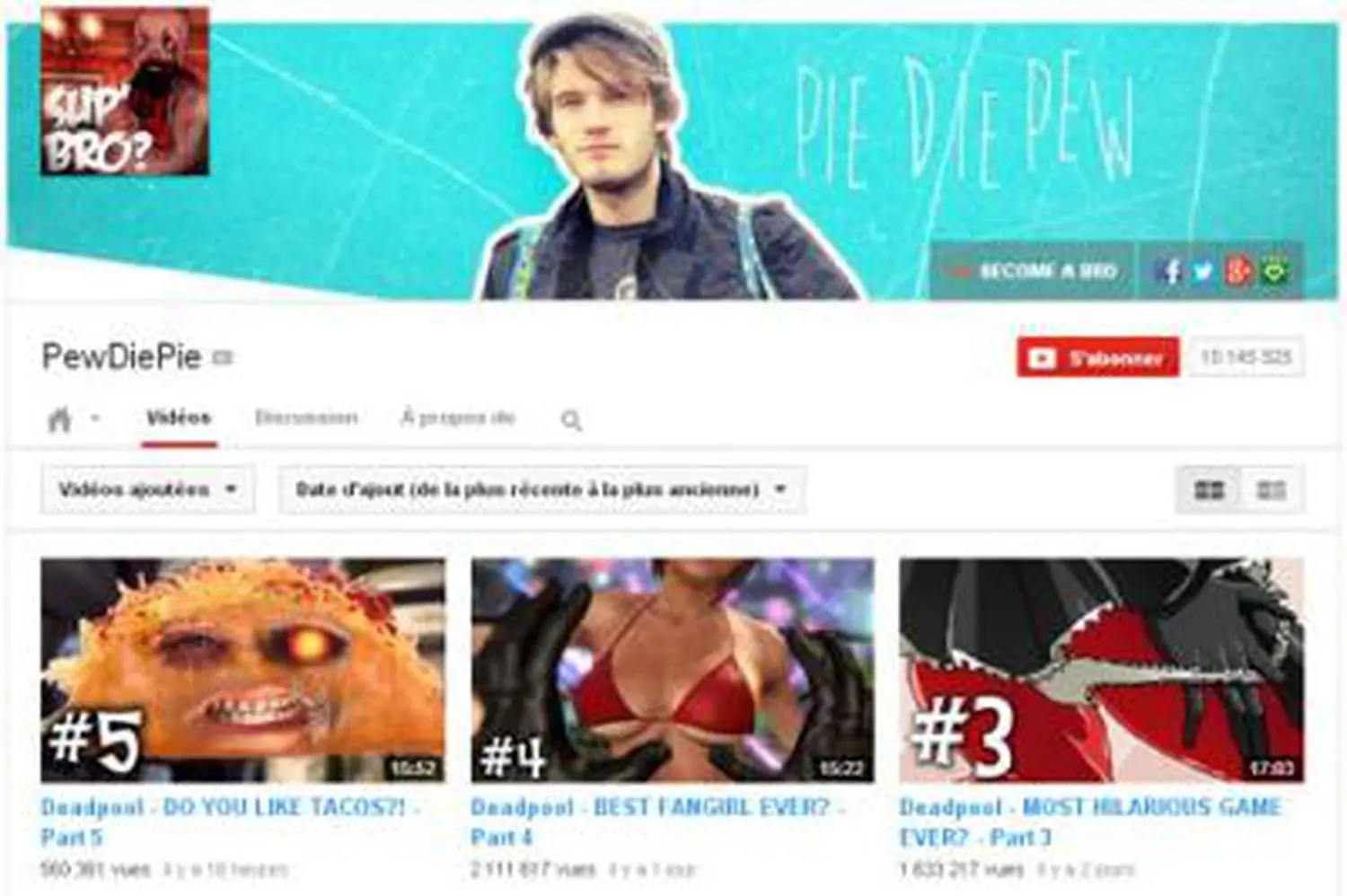
In the rapidly shifting hierarchy of online video, a Swedish gamer named Félix Kjellberg has taken the crown as the new king of YouTube. At just 23, Kjellberg—better known to millions of viewers as PewDiePie—has built a channel devoted to video games into one of the most powerful audiences on the internet. His page has recorded 1.96 billion views and more than 10 million subscribers. The figures place him ahead of Psy's Gangnam Style, the music video that had held the title of the most-viewed clip with more than 1.7 billion views. In a single record week, 349,000 YouTube users subscribed to his channel and became what he calls his "bros".
The comparison is not between two identical formats. Psy's Gangnam Style is a single music video, while PewDiePie's total is cumulative across a vast library of uploads. Yet the milestone still signaled a broader shift: a personality-led gaming channel had drawn more total views than one of the most famous viral clips in the world. It showed that YouTube's audience was not only watching polished music videos or professional productions; it was also spending enormous amounts of time with creators who filmed themselves playing games, reacting to jumpscares, and talking directly to the camera.
Key facts at a glance
- Félix Kjellberg, known as PewDiePie, is a Swedish video game commentator.
- His channel reached 1.96 billion views and more than 10 million subscribers.
- He surpassed Psy's Gangnam Style, which had more than 1.7 billion views.
- In one record week, 349,000 users subscribed to his channel.
- He calls his fans "bros".
- His content consists of filmed gameplay with energetic, often chaotic commentary.
- He ranked second in subscribers behind Smosh, which had 11 million, and ahead of Jenna Marbles with 9 million.
- Google's Think Insights noted that Generation C viewers were twice as likely to watch YouTube than television.
The formula: gameplay, personality and chaos
Kjellberg's method is deceptively simple. He films himself playing video games and comments on the action with a mixture of humor, surprise, frustration and theatrical panic. The games vary, but the appeal lies less in expert play than in the running commentary and the sense that viewers are sharing a moment with him. His fans do not tune in for a silent walkthrough or a clinical review. They come for the reactions, the jokes and the feeling of belonging to a community that he addresses directly. That community is central to the channel's identity. He calls his subscribers his "bros", a term that turns audience members into participants in an ongoing inside joke.
The approach fits a generation that grew up with the internet as a natural part of daily life. Google's Think Insights described this group as Generation C, for connected, and noted that these viewers were twice as likely to watch videos on YouTube as on television. For them, a creator filming a game session in a bedroom could feel more immediate and more relatable than a tightly produced broadcast. The lack of polish was not a weakness; it was part of the authenticity. PewDiePie's stated goal was simple: to share moments of video games on YouTube with his "bros". That direct relationship between creator and audience helped explain why subscribers arrived in such large numbers.
From a bedroom channel to a record-breaking audience
Félix Kjellberg launched his YouTube channel in 2010, when he was still an unknown creator in Sweden. Early uploads included gameplay videos and commentary, but the formula did not become a mass phenomenon overnight. His breakthrough came through horror games, where his exaggerated reactions and nervous energy gave viewers a reason to keep watching. Games such as Amnesia: The Dark Descent became ideal material for a style built on tension, sudden scares and comic overreaction. Over time, the channel expanded into a wider range of titles, but the core remained the same: a game on the screen, a personality in the foreground, and an audience invited to react along with him.
The growth of the channel reflected a larger change in what YouTube was becoming. The platform had been founded in 2005 and acquired by Google in 2006. In its early years, it was often seen as a place for short clips, amateur skits and accidental viral moments. By the early 2010s, it had become a launching pad for professional creators who built careers around regular uploads. Gaming was one of the categories driving that shift. The "Let's Play" format, in which a creator records a game session and comments on it, turned gameplay into a form of entertainment that could be watched for hours. PewDiePie became one of the most visible beneficiaries of that trend.
The Psy comparison and the meaning of the record
Psy's Gangnam Style had become a global phenomenon after its release in 2012. Its catchy hook, memorable dance and humorous video made it the first clip to reach one billion views on YouTube, and it remained the most-viewed video on the platform for years. The fact that a gaming channel could surpass its cumulative view count was therefore more than a statistical footnote. It illustrated how quickly audience behavior was changing. A single viral music video could attract the world's attention, but a creator with a steady upload schedule could accumulate an enormous audience over time. The record was not simply about one video beating another; it was about a new kind of media figure whose output was continuous, conversational and built on community.
PewDiePie's record week added another dimension to the story. In the space of seven days, 349,000 users subscribed to his channel. That number represented more than a passing spike. It showed how a single creator could convert views into a durable following, with each new subscriber receiving future uploads and joining the "bros" community. For YouTube, such figures demonstrated the power of personalities who could keep audiences coming back without the backing of a traditional broadcaster. For advertisers and media companies, they suggested that gaming content was no longer a niche interest but a central part of online culture.
The subscriber race behind the view record
Despite holding the most-viewed channel, Kjellberg was not yet the most-subscribed creator on YouTube. In the subscriber rankings, he remained in second place behind Smosh, which had 11 million subscribers, and ahead of Jenna Marbles, who had 9 million. That distinction mattered because views and subscribers measured different things. Views showed how often content was watched; subscribers showed how many people wanted to be notified about future uploads. PewDiePie's position in both tables made him a rare double threat, but it also showed that the race for YouTube dominance was still competitive. Smosh had built its audience through comedy and sketch videos, while Jenna Marbles had attracted viewers with personality-driven content. Each creator represented a different route to success on the same platform.
The competition also revealed how quickly the hierarchy could change. A record week of 349,000 new subscribers could alter the standings, and a single viral series could push a channel into a new tier. For creators, the lesson was that consistency mattered as much as a breakout moment. PewDiePie's rise was not the result of one video alone. It came from years of uploads, a recognizable persona and a direct style of address that made viewers feel like they knew him. That combination turned a hobby into a full-time career and made a 23-year-old Swedish gamer the subject of a global audience record.
Why the gaming channel mattered
The success of PewDiePie also highlighted the economic and cultural potential of gaming content. Video games had long been a major entertainment industry, but watching someone else play was still treated by many as an unusual pastime. The rise of the "Let's Play" format challenged that assumption. Audiences watched for the commentary, the skill, the humor or simply the companionship of a familiar voice. For younger viewers, a gaming channel could feel as natural as watching a television show. For creators, it opened a path to build a business around an audience that valued authenticity and direct contact.
That shift had implications beyond one channel. It encouraged more creators to treat YouTube as a primary platform rather than a side project. It showed that gaming could support long-form content, not just short clips. And it demonstrated that a creator's personality could be the main product, with the game serving as a setting rather than the sole attraction. PewDiePie's channel became a case study in that model: a performer, a community and a steady stream of content that turned gameplay into a shared ritual.
At the time of the record, the numbers told a clear story. Félix Kjellberg had 1.96 billion views, more than 10 million subscribers and a weekly gain of 349,000 subscribers. He had overtaken Psy's Gangnam Style in cumulative views, even though the comparison involved a channel and a single video. He called his fans "bros", filmed himself playing games and built a following that watched him for his reactions as much as for the games themselves. In the subscriber table, he remained behind Smosh and ahead of Jenna Marbles, with the next stage of the race still open.
Source: Linternaute News