

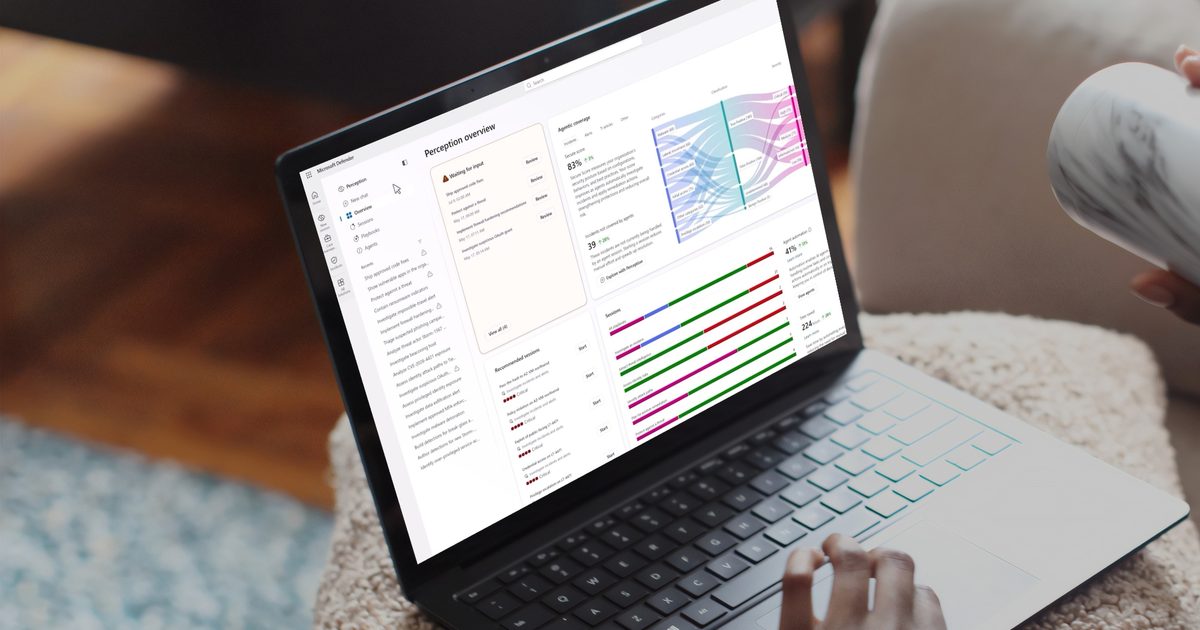
AI-Driven Security: A New Paradigm
The cybersecurity landscape has undergone a radical transformation. Attacks that once required days of manual reconnaissance can now be scripted and executed by AI in seconds. Traditional security tools, designed for a slower, human-paced world, are struggling to keep up. Microsoft believes it has found the answer in a concept called Project Perception—an AI-native security system that thinks and reacts at machine speed.
Project Perception is not just another threat detection dashboard. It is an agentic AI system, meaning it can autonomously reason, plan, and execute actions across an organization’s entire digital environment. Instead of overwhelming security teams with alerts, it aims to automate the entire cycle of vulnerability discovery, risk assessment, and remediation.
The Three-Agent Team: Red, Blue, and Green
At the heart of Project Perception are three specialized AI agents that work in concert. The Red team agent continuously scans for weaknesses, mimicking the behavior of real attackers. It probes identities, devices, apps, data, and cloud configurations to find exploitable gaps before malicious actors do. Once a potential vulnerability is flagged, the Blue team agent takes over. It investigates the finding in depth, correlating it with threat intelligence and contextual data to determine whether it poses a genuine risk. If the threat is confirmed, the Green team agent steps in to automatically apply fixes—such as patching a misconfigured cloud service, adjusting access controls, or deploying a virtual patch—all while maintaining a clear audit trail for human review.
This triage loop is designed to be continuous and self-improving. Each agent learns from the actions of the others, and the entire system becomes more effective over time. Crucially, Microsoft emphasizes that a human remains in charge of all critical decisions, ensuring that automated responses align with organizational policies and risk tolerance.
Why Microsoft Believes It Has an Edge
Microsoft’s competitive advantage stems from its unparalleled visibility into the digital estate. The company protects billions of identities, millions of devices, and vast cloud workloads across its own ecosystem and third-party platforms. This telemetry feeds into a multi-model AI architecture that selects the best model for each specific task—rather than relying on a one-size-fits-all language model. For example, a lightweight model might handle routine vulnerability classification, while a more powerful reasoning model is reserved for complex threat analysis.
Underpinning this is what Microsoft calls a cyber stack: a chain that converts raw signals (e.g., log entries, network flows, identity events) into enriched context, which is then fed to AI models and agents that take action. The output is not just a pretty dashboard but actionable steps that defenders can execute immediately. This approach reduces alert fatigue and speeds up the mean time to respond (MTTR), which is often the most critical metric in security operations.
Early Results: MAI-Cyber-1-Flash
One concrete example already in production is MAI-Cyber-1-Flash, a specialized AI model that Microsoft has built for vulnerability management. It now runs inside MDASH, the company’s vulnerability management tool. According to Microsoft, MAI-Cyber-1-Flash scores 96% on the CyberGym benchmark, a performance metric for cybersecurity AI models. That is 12 points higher than its predecessor, Mythos, and the model achieves this with nearly half the cost. These early results suggest that specialized, purpose-built AI models can outperform general-purpose ones in security contexts, a lesson Microsoft is applying across Project Perception.
Historical Context: The Evolution of Microsoft Security
Microsoft has been iterating on security for decades. From the early days of Windows Defender to the modern Microsoft 365 Defender suite, the company has gradually moved from signature-based antivirus to behavioral analytics and now to AI-driven proactive defense. Project Perception represents the next logical step: an autonomous system that can anticipate and neutralize threats before they materialize into breaches.
The rise of generative AI has accelerated this shift. Attackers now use AI to craft convincing phishing emails, generate polymorphic malware, and even find zero-day vulnerabilities. Traditional security operations centers (SOCs) are overwhelmed. A 2024 survey by the Ponemon Institute found that the average time to identify a breach is 207 days. Microsoft argues that only machine-speed AI can close this gap.
Implications for the Cybersecurity Industry
If Project Perception fulfills its promise, it could fundamentally alter the cybersecurity market. Many existing tools focus on detection and alerting, leaving remediation to human analysts. An AI that can automatically fix vulnerabilities—especially those in cloud configurations, identity misconfigurations, and application code—could drastically reduce the workload on already strained security teams. However, concerns about false positives and over-automation remain. Microsoft has committed to building Project Perception around its Responsible AI principles from day one, ensuring transparency, accountability, and human oversight.
Competitors like CrowdStrike, Palo Alto Networks, and SentinelOne are also investing heavily in AI. The race is on to see who can build the most reliable, scalable, and trustworthy autonomous security system. Microsoft’s advantage lies in its integration across the entire IT stack—Azure, Microsoft 365, GitHub, and LinkedIn—giving it data breadth that few rivals can match.
Project Perception is scheduled to enter public preview on August 3. Organizations interested in early access can sign up through Microsoft’s security portal. As the lines between human and machine capabilities continue to blur, the question is no longer whether AI will dominate cybersecurity, but which organizations will learn to wield it effectively and responsibly.
Source: Digital Trends News