

The Federal Communications Commission has significantly tightened restrictions on foreign-made robotics, announcing that advanced robotic devices manufactured outside the United States are now on its Covered List. The list is the FCC’s official catalog of communications equipment and services that the U.S. government considers an unacceptable threat to national security. Once a product is placed on the list, it cannot receive the necessary FCC equipment authorization, which is mandatory for most electronic devices sold or imported into the country.
The change affects a wide range of products. The FCC specifically highlighted limbed robots, including humanoid robots and quadruped robots. That means technologies such as humanoid robots and robot dogs from non-U.S. companies are now prohibited from entering the U.S. market. But the rule goes much further: the FCC has confirmed that robot vacuums are also covered by the ban.
Consumers in the United States will no longer be able to buy new robot vacuums from major brands such as Roborock, Ecovacs, Dreame, and Samsung. These companies have built extensive distribution networks in the U.S., and their devices are among the most popular robotic cleaners on the market. The ban blocks new imports and sales, but it does not require anyone to stop using a robot vacuum they already own.
What Counts as an Advanced Robotic Device?
According to the National Security Determination cited by the FCC, an advanced robotic device is a mechanical mobile device that is capable of locomotion, obstacle avoidance, navigation, or movement on the ground. It must be able to operate at a distance from a human operator or supervisor, whether through commands, sensor data, or a combination of both. The device and its docking station, if applicable, must weigh more than 4.4 pounds. Finally, it must include sensors to perceive its environment, networking components that support wired or wireless connections with speeds of at least 200 kilobits per second, and software that controls autonomous navigation, movement perception, data collection, or remote command-and-control.
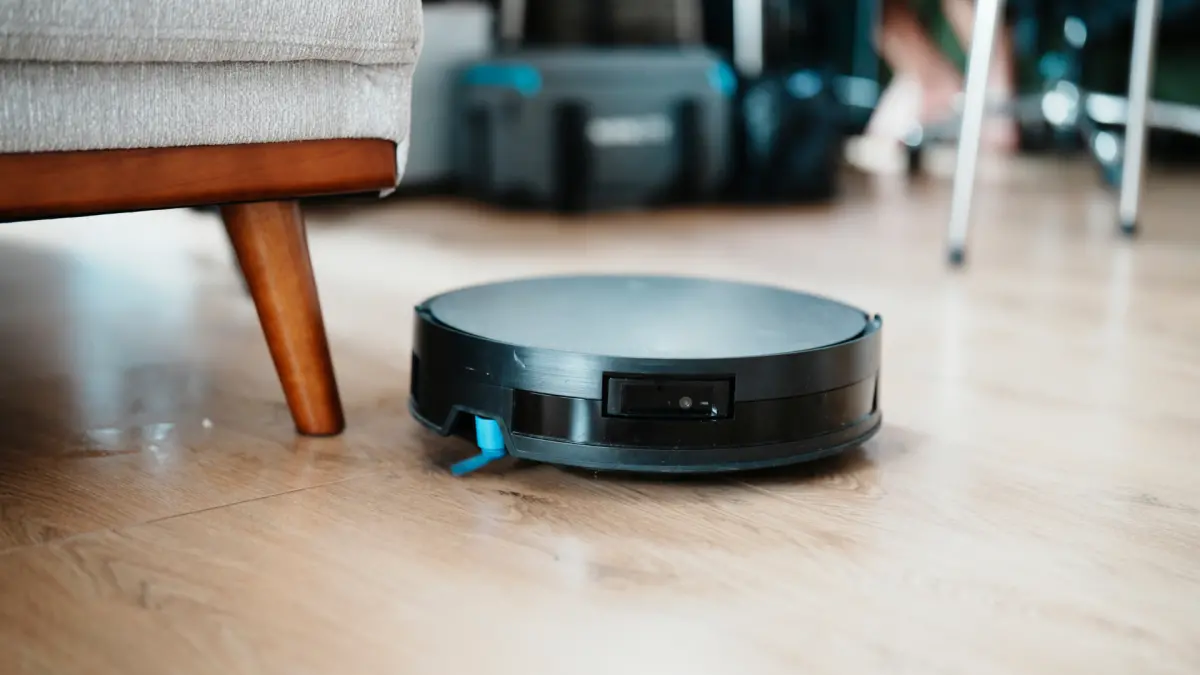
Robot vacuums are a textbook match for this definition. They rely on environmental sensors to map rooms, avoid stairs, and detect dirt. They connect to home WiFi networks so users can start or schedule cleaning sessions from a smartphone app. Their onboard software processes sensor data and makes decisions about where to go next. The FCC has since confirmed that these features place robot vacuums squarely within the scope of the ban.
Why the U.S. Issued the Ban
The U.S. government says the connected nature of advanced robots creates serious cybersecurity vulnerabilities. A robot that can move through a home, perceive its surroundings, and transmit data over the internet could be compromised in ways that threaten both privacy and physical safety. The National Security Determination warns that relying on foreign-produced advanced robotic devices presents unacceptable supply chain and cybersecurity vulnerabilities.
One recent incident appears to have shaped the government’s thinking. Earlier this year, a software engineer accidentally hacked a robot vacuum made by DJI, the Chinese company best known for its drones. The engineer gained access to video, audio, and map data from thousands of devices around the world. DJI had already been classified as a Chinese military company and its products were already barred from the United States. The robot vacuum hack nonetheless demonstrated how a single flaw can expose enormous amounts of personal data.
Security incidents are not exclusive to foreign-made devices. U.S. technology giants such as Amazon, Meta, and Uber have all experienced safety and security failures. Any networked device can be vulnerable, regardless of where it was designed or built. In this case, however, the U.S. government views the risks from foreign robotics as substantial enough to justify an outright ban.
What Happens to Current and Future Ownership?
There is good news for people who already have a robot vacuum at home. The FCC says consumers are still permitted to use devices they already own. The ban does not revoke authorization from devices that were approved before the new rule took effect. Existing inventory that has already received authorization can still be sold, so some older models will remain available in U.S. stores for a while.
The bigger impact will be on future products. Any robot vacuum that has not yet received FCC authorization cannot be imported or sold in the United States. That means new generations of robot vacuums, even those from trusted global brands, may launch in Europe or Asia without ever reaching U.S. customers. Over time, the selection of available models will shrink and older models will become increasingly outdated.
An Industry Dominated by Foreign Manufacturers
The ban lands hardest on a market that is overwhelmingly dependent on non-U.S. manufacturing. The five largest robot vacuum manufacturers in the world are all based in China, and together they held nearly 70 percent of the global market share as of 2025. These companies make some of the most advanced and affordable robotic cleaners sold in the United States. Without them, American consumers have few comparable alternatives.
The U.S. has practically no domestic robot vacuum manufacturing. iRobot, the maker of Roomba, was founded in California and became one of the most recognizable American names in robotics. But iRobot filed for bankruptcy in 2025 and was acquired by Picea, a Chinese robotics company. This acquisition underscores the difficulty of finding an American-made robot vacuum that could replace the banned imports.
A Broader Pattern of Tech Restrictions
Tuesday’s announcement is not the first time the FCC has moved to block foreign-made consumer technology. Earlier this year, the FCC banned all foreign-made consumer-level WiFi routers, also citing national security concerns. The majority of routers are manufactured outside the United States, including popular models from TP-Link, ASUS, and Netgear. That decision disrupted the market and raised questions about how far the government would go in restricting everyday connected devices.
The robot vacuum ban extends that logic to machines that can physically move through private spaces. Unlike routers, which simply pass data, robot vacuums carry cameras, microphones, and sensors while navigating a home. They can map the floor plan of a house and identify furniture, doors, and walls. In the wrong hands, that data could be used for surveillance or other malicious purposes.
The Department of War and the Department of Homeland Security are authorized to grant exemptions to the robotics ban after completing national security assessments. These exemptions would allow certain devices to enter the U.S. market despite the general prohibition. At the time of writing, the FCC has not listed any such exemptions.
Source: Mashable News