

Handheld gaming systems have grown far beyond simple portable consoles. Today's market spans compact retro emulators, powerful PC handhelds, and innovative niche devices. Choosing the best one starts with understanding how, where, and what you want to play. The variety is exciting, but it also makes the shopping process harder. The “best” gaming handheld now depends less on a single standout product and more on your personal gaming habits.
Some handhelds are built for quick sessions and classic libraries, prioritizing simplicity, long battery life, and pocket-friendly designs. Others blur the line between console and PC, offering large screens, powerful chips, and access to massive game libraries. More experimental options focus on unusual controls or intentionally limited experiences. After months of testing and tracking the fast-moving handheld space, these are the devices that stand out in an increasingly crowded field.
Best handheld gaming PC for most: Steam Deck
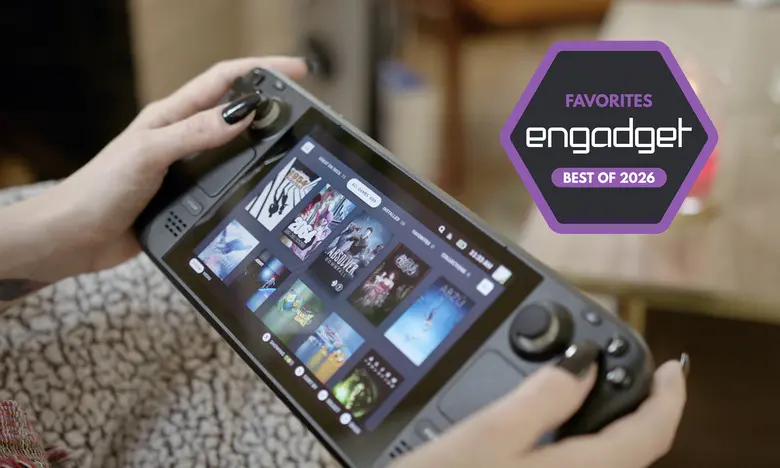
The Steam Deck remains the best balance of price, performance, and usability in the gaming handheld market. The Steam Deck OLED is a thorough upgrade over the original, starting at $549 for 512GB of storage. It features a 7.4-inch HDR OLED display with a 1280 x 800 resolution, 1000 nits peak HDR brightness, and up to a 90Hz refresh rate. The custom 6nm AMD APU, 16GB of LPDDR5 memory, and 50Whr battery provide better efficiency than the LCD model.
Key facts:
- Display: 7.4-inch HDR OLED, 1280 x 800, up to 90Hz
- Processor: Custom 6nm AMD APU
- RAM: 16GB LPDDR5
- Storage: 512GB or 1TB SSD
- Battery: 50Whr
- Weight: 1.41 pounds
- OS: SteamOS
The OLED model lasts three to 12 hours depending on the game, versus two to eight hours on the LCD version. The original LCD model, starting at $399, remains a strong budget pick with the same core experience for $150 less. Both models can play a massive library of Steam games, including recent hits like Elden Ring and Final Fantasy VII Rebirth, though the hardware is aging in 2026. Some graphical AAA titles struggle, and anti-cheat software can block live-service games. Still, the Deck is also a superb emulation machine thanks to community tools like EmuDeck.
Pros: Enough power for many modern PC games, user-friendly interface, vivid OLED display, fantastic value on the LCD model. Cons: Bulky, not the most powerful hardware, limited to official Steam support for some titles.
Best premium handheld gaming PC: Lenovo Legion Go S
The Lenovo Legion Go S (SteamOS, Z1 Extreme) is the closest thing to a Steam Deck 2. It is the first third-party device to natively run SteamOS, bringing the same convenient software to more modern hardware. The tested configuration includes an AMD Ryzen Z1 Extreme processor, 32GB of RAM, and a 1TB SSD. It can reach 33W of power draw handheld or 40W plugged in, well above the Steam Deck's 15W.
Key facts:
- Display: 8-inch IPS, 1920 x 1200, 120Hz, VRR
- Processor: AMD Ryzen Z1 Extreme
- RAM: 32GB LPDDR5
- Storage: 1TB SSD
- Battery: 55.5Whr
- Weight: 1.61 pounds
- OS: SteamOS
This device offers better performance than the Steam Deck in demanding games, and the larger display with variable refresh rate reduces screen tearing. The design is comfortable, with rounded edges and textured grips, plus Hall effect joysticks to avoid drift. However, it is heavier, louder under load, and lacks HDR. The Z1 Extreme version costs $900, while a cheaper Z2 Go model starts at $650 but hasn't been fully tested yet.
Pros: Better performance than Steam Deck, official SteamOS, spacious display with VRR, good ergonomics. Cons: Pricey, heavier than Steam Deck, no HDR, weak haptics.
Best Windows gaming handheld: ASUS ROG Xbox Ally X
If you want maximum software flexibility and a higher performance ceiling, the ASUS ROG Xbox Ally X is the top Windows handheld. It runs Windows 11 with a new “Xbox full screen experience” that aggregates PC games from multiple storefronts and makes gamepad navigation easier. It is not an actual Xbox, but it works with Game Pass, Epic, GOG, and other services without workarounds.
Key facts:
- Display: 7-inch IPS, 1080p, 120Hz, VRR
- Processor: AMD Ryzen Z2 Extreme
- RAM: 24GB LPDDR5X
- Storage: 1TB SSD
- Battery: 80Whr
- Weight: 1.58 pounds
- OS: Windows 11
Performance is a major selling point. The Ryzen Z2 Extreme chip and 35W mode deliver much better frame rates than the Steam Deck, especially in AAA games. The 1080p display is sharp and supports VRR, though it lacks OLED contrast. Battery life is strong for a Windows handheld, with roughly three and a half hours in demanding games. The comfortable grips make it feel like an Xbox controller, and the speakers are loud.
But at $1,000, it is a luxury purchase. Windows quirks still annoy, and the device is bulky. The lower-cost $600 ROG Xbox Ally is not recommended due to weaker specs. Pros: More powerful than Steam Deck, works with any Windows client, comfortable grips, full-screen Xbox experience. Cons: Expensive, bulky, Windows 11 quirks, lackluster haptics, no case.
Best mobile gaming handheld for most people: Retroid Pocket 5
For emulation-focused gamers who want a compact device, the Retroid Pocket 5 is the pick. It runs Android and costs $219. The Snapdragon 865 chip and 8GB of RAM can handle PlayStation 2 and GameCube games at full speed with upscaling. It also nails PSP, Dreamcast, PS1, and N64 emulation, and runs native Android games well.
Key facts:
- Display: 5.5-inch OLED, 1080p, 60Hz
- Processor: Qualcomm Snapdragon 865
- RAM: 8GB LPDDR4x
- Storage: 128GB UFS 3.1
- Battery: 5,000mAh
- Weight: 0.62 pounds
- OS: Android 13
The OLED display is vibrant and sharp, the buttons feel great, and the active cooling system prevents overheating. However, emulator setup is extremely tedious, and the joystick layout is awkward for modern games. Battery life ranges from three to over ten hours depending on the workload. Pros: Capable emulation, lovely OLED display, sturdy design. Cons: Requires heavy tinkering, joystick layout not ideal.
Another good option: Retroid Pocket Flip 2
The Retroid Pocket Flip 2 is essentially the Pocket 5 in a clamshell shape, priced at $229. It has the same Snapdragon 865 chip, OLED display, Hall effect joysticks, cooling fan, and battery. The clamshell provides natural screen protection, and the joysticks are offset for better ergonomics. However, it is thicker and heavier, the recessed joysticks feel odd, and the buttons could be larger. Pros: Capable emulation, sturdy clamshell, lovely display. Cons: Lots of tinkering required, recessed joysticks, small buttons.
Best mobile gaming handheld overall: AYN Odin 2
If you want a higher-performing emulation device, the AYN Odin 2 starts at $299. Its Snapdragon 8 Gen 2 processor plays PS2 and GameCube games at two to three times native resolution, and handles 3DS and Wii well. The 6-inch 1080p IPS display is bright and sharp, and battery life is superb, often exceeding eight hours on demanding emulation and 20 hours on lighter tasks.
Key facts:
- Display: 6-inch IPS, 1080p, 60Hz
- Processor: Qualcomm Snapdragon 8 Gen 2
- RAM: 8GB, 12GB, or 16GB
- Storage: 128GB, 256GB, or 512GB
- Battery: 8,000mAh
- Weight: 0.93 pounds
- OS: Android 13
The curved grips, Hall effect joysticks, fingerprint scanner, and front-facing speakers make it a refined device. It is more expensive than Retroid options, and emulator setup is still laborious. Pros: Excellent emulation, comfortable, great battery. Cons: Relatively pricey, setup can be tedious, docked experience not seamless.
Best Game Boy-style handheld: Analogue Pocket
The Analogue Pocket is the ultimate way to play Game Boy games. Priced at $220, it uses FPGA hardware to run cartridges with near-perfect accuracy. It works with Game Boy, Game Boy Color, and Game Boy Advance, plus optional adapters for Game Gear, Neo Geo Pocket, and other systems. The 3.5-inch display is incredibly sharp, and the build quality is excellent.
Key facts:
- Display: 3.5-inch LCD, 1600 x 1440, VRR
- Chipset: Altera Cyclone V FPGA, Altera Cyclone 10 FPGA
- Battery: 4,300mAh
- Weight: 0.61 pounds
- OS: Analogue OS
It also supports microSD card-based emulation for systems like SNES and Genesis. Cons include frequent stock shortages and spongy shoulder buttons. Pros: Near-perfect emulation of cartridges, gorgeous display, expandable. Cons: Stock issues, spongy shoulder buttons, tiny volume buttons.
Honorable mention: Playdate
The Playdate is a tiny yellow handheld with a 2.7-inch monochrome display and a physical crank. It costs $229 and is designed for quirky indie games. It has a built-in store and sideloading options, and its battery lasts six to eight hours. It is not a great value, but it is a fun, focused device. Pros: Unique design, well-built, thoughtful game library. Cons: Expensive for its niche, no backlit display.
What about the Nintendo Switch 2?
The Nintendo Switch 2 is more popular than any of these handhelds, but it exists in its own world. It is the only place to legally play new Nintendo exclusives, and it offers a polished take on the original Switch with a bigger 7.9-inch display, magnetic Joy-Cons, and improved performance. However, the exclusive game library is still limited, so it is not a must-buy for everyone unless you have a serious case of FOMO.
Other handhelds we've tested
Several other noteworthy devices have been tested. The Lenovo Legion Go 2 has a vivid 8.8-inch OLED display and detachable controllers, but it weighs over two pounds and costs more than $1,100. The MSI Claw 8 AI+ offers strong performance with an Intel Core Ultra 7 chip, but its $1,100 price is hard to justify over the ROG Xbox Ally X. The ModRetro Chromatic plays Game Boy cartridges with premium metal hardware but requires AA batteries and lacks save states. The Ayaneo Flip DS is a dual-screen Windows handheld that runs hot and costs over $1,100. The Retroid Pocket Classic is a budget-friendly Game Boy-style Android handheld at $129. The Retroid Pocket Mini is a smaller but pricier retro option. The Miyoo Mini Plus and TrimUI Brick are low-cost alternatives, while the Anbernic RG35XX Plus has software issues. The PlayStation Portal and Logitech G Cloud are cloud-streaming devices with limited appeal.
What to know about the gaming handheld market
The market splits into three tiers. The top tier includes x86-based portable PCs like the Steam Deck and ROG Xbox Ally X. These are the most powerful, capable of playing modern PC games, but they are large, expensive, and battery-hungry. The second tier includes Android and Linux handhelds under $400, such as the Retroid Pocket series, which are compact and great for emulation but require more setup. The third tier includes unique devices like the Switch 2 and Playdate that run custom software and offer exclusive experiences. When buying, consider your game library, your tolerance for tinkering, and whether you need portability or performance. The best handheld for 2026 is the one that matches your gaming lifestyle.
Source: Engadget News