

Headline and key facts
Headline: AI image generators in 2026 have one clear winner, with Google’s Nano Banana Pro taking a near-perfect score in a new nine-prompt comparison.
- Six paid AI image generators were tested with the same nine prompts.
- Google’s Nano Banana Pro finished first with 93%, far ahead of ChatGPT at 74%.
- Midjourney scored 57%, Adobe Firefly 54%, Leonardo AI 52%, and Canva 43%.
- The test suite covered existing-image revision, original image generation, text inside images, and pop-culture references.
- Nano Banana Pro cost $19.99 per month as part of Google AI Pro; ChatGPT cost $20 per month as part of ChatGPT Plus.
- All six tools produced usable logos, but results diverged sharply on photo cleanup, text rendering, and pop-culture prompts.
- Nano Banana Pro still had flaws: a watermark, one confusing session error, and a misspelled word on a restored truck image.
- Adobe Firefly was the most restrictive, while Canva delivered the weakest overall image-editing results.
The comparison used identical prompts and a spreadsheet-based scoring system. Each image was judged on whether it preserved the original subject, followed the prompt, rendered readable text, and produced a convincing visual result. The spread between first and last place was unusually wide, suggesting that paid AI image tools are no longer separated by small quality differences. The strongest model now handles several jobs that used to require separate workflows, while weaker tools remain useful mainly for narrow creative tasks.
A decisive winner in a crowded market
The headline result is not close. Google’s Nano Banana Pro, part of the Gemini 3 family, scored 93% and won every category in the test set. That kind of result is rare in comparative AI reviews because most tools tend to trade strengths and weaknesses. One model may be better at photorealism, another at illustration, and another at text. In this comparison, Nano Banana Pro combined those capabilities with fewer failures than any competitor.
The margin matters for buyers. ChatGPT finished second at 74%, a respectable score but 19 percentage points behind the leader. The remaining four tools landed between 43% and 57%, meaning they failed or partially failed a large share of the tasks. For users who need an all-purpose image generator, the practical choice is much narrower than the number of available subscriptions suggests.
How the tests were structured
The evaluation used nine prompts across four categories: revising existing images, generating original images, adding text to images, and leveraging pop culture. All images were generated in a 1:1 square ratio so they could be compared side by side. The prompts were not designed to be easy. They included a photo recontextualization task, two restoration assignments, a logo brief, a fantasy illustration, two social-media-style portraits with text, and two pop-culture-inspired images.
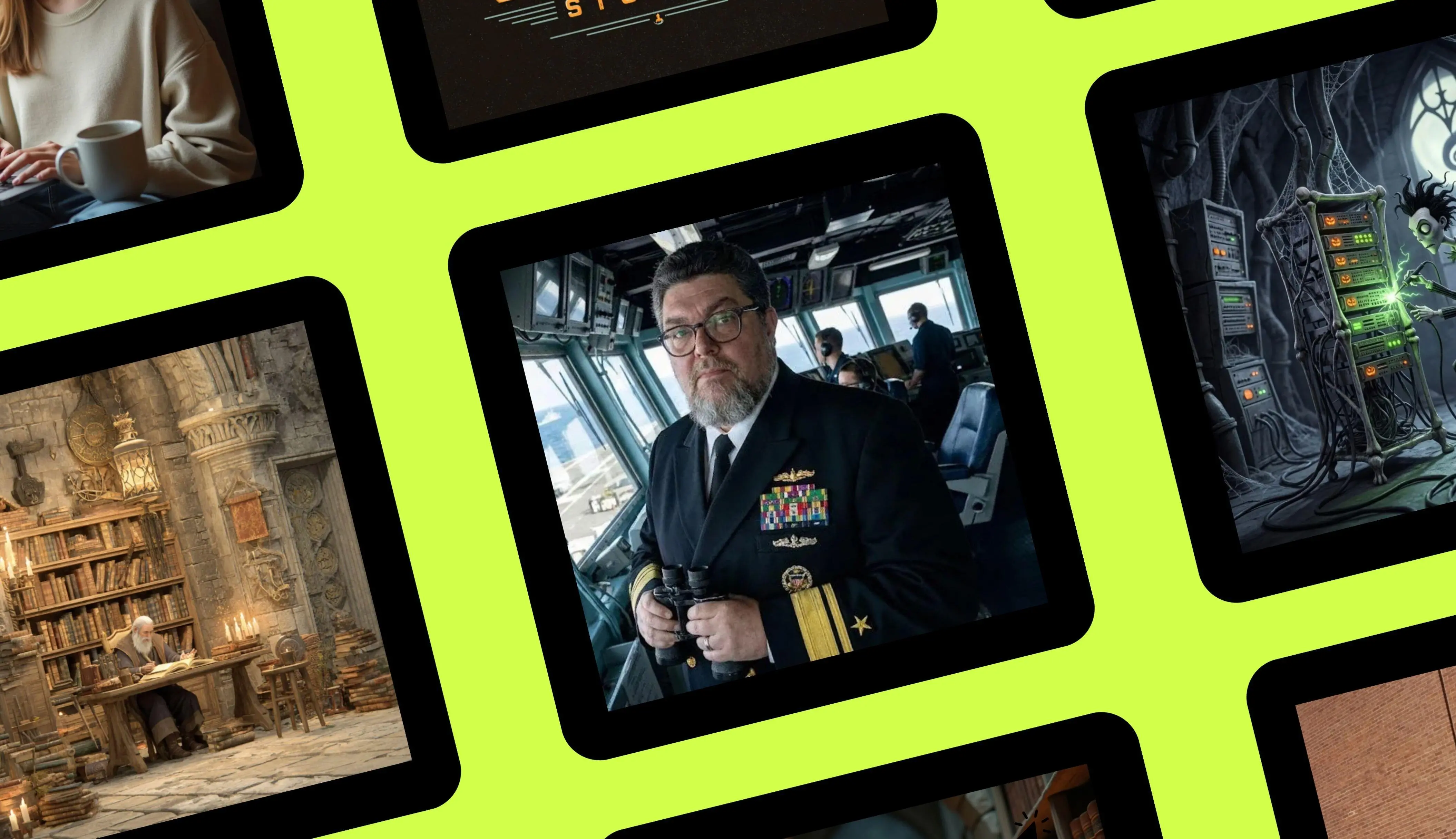
The first category tested whether a model could take an existing photograph and transform it without losing the subject’s identity. One prompt asked the AI to dress a man in a US Navy admiral’s uniform and place him on the bridge of an aircraft carrier while keeping his face unchanged. Another asked for restoration of an old black-and-white photograph. A third asked for restoration and colorization of a black-and-white image of a truck, including preservation of the original lettering.
The second category tested original generation. One prompt requested a retro-futuristic logo for a video studio called Space Coast Studios. Another asked for a medieval librarian in a candlelit stone library. These tasks measured composition, theme adherence, and visual polish.
The third category focused on text inside images. One prompt asked for a photorealistic studio portrait of a stylish senior adult wearing glasses and holding a flagship smartphone, with short ad copy over the image. Another asked for a candid portrait of a student using a MacBook Pro near a window, with a cup of coffee and lifestyle copy. These tests exposed whether a model could place readable, well-designed text without mangling spelling or contrast.
The fourth category used pop culture. One prompt asked for a poster for a fictional fourth Back to the Future movie in which Marty McFly travels to 1920s New York City. Another asked for a Nightmare Before Christmas and Tim Burton style image of an IT professional in a data center. These prompts tested cultural recognition, style transfer, and the ability to handle references without refusing the request.
Nano Banana Pro: 93%
Nano Banana Pro earned the top score by a wide margin. It preserved faces in recontextualized images, kept original details during restoration, generated readable text, and handled pop-culture prompts with unusual accuracy. In the admiral test, it kept the subject’s face and glasses, changed the angle of the pose, placed him on a ship bridge, and added binoculars. It also produced a strong cleanup of an old childhood photo, making a dark image visible while preserving the original face.
The model was not perfect. In one truck restoration attempt, it returned an unrelated colorized portrait before eventually producing a truck image in a new session. In the final truck output, the lettering was mostly readable but contained a misspelling. Nano Banana Pro also adds a watermark in the bottom corner of each image, which is an annoyance for users who want clean output. Even with those deductions, the overall score remained near perfect because the model succeeded on nearly every other prompt.
The creative tests were especially strong. The Space Coast Studios logo included a palm tree, rocket, film reference, and accurate text. The medieval librarian image matched the candlelit stone-library brief. The social media portraits placed text cleanly and correctly. The Back to the Future poster included a DeLorean, a skateboard, period clothing, and a convincing logo treatment, with a tagline and a New York City 1925 marquee. The Nightmare Before Christmas style IT image also captured the requested aesthetic. For users who want one subscription that covers many image tasks, Nano Banana Pro set the benchmark in this comparison.
ChatGPT: 74%
ChatGPT finished second, with its strongest advantage in natural-language iteration. Users can describe changes conversationally and refine an image across multiple turns, which makes the tool approachable for beginners and useful for brainstorming. The image generator inside ChatGPT is no longer a separate DALL-E experience; it is integrated into the chat product, and the latest update improved several outputs compared with earlier versions.
Photo retouching remained a weak point. In the admiral test, the face looked like the original subject, but the uniform insignia were unclear and seemed to mix ranks. The childhood photo restoration was good and preserved the original face. The truck cleanup improved lettering compared with an earlier version, but it still changed the original text and added spacing errors. The logo and librarian images were acceptable, though the logo lacked a Florida or palm-tree reference that would have strengthened the theme.
The social media prompts produced correct text, but both text blocks were placed in exactly the same position. The lighter font style and weaker contrast made the copy harder to read. The pop-culture category was inconsistent. One earlier test recreated a Star Trek scene with impressive detail, but the Back to the Future and Nightmare Before Christmas prompts did not produce usable images in the new version. That inconsistency pulled the score down from what an earlier version had achieved. ChatGPT remains a strong option for conversational iteration, but it is not the most reliable all-purpose image generator in this test set.
Midjourney: 57%
Midjourney is best known for hyper-creative, cinematic imagery, and the test results reflect that reputation. The librarian image was almost exactly what the prompt described, and the Nightmare Before Christmas style IT professional was one of the most striking images in the entire comparison. When Midjourney works, it produces visuals with a distinct artistic point of view that many users find more compelling than safer, more literal outputs.
The tool struggled with existing-image work. In the admiral test, it reproduced a yellow shirt and some background elements but did not preserve the subject’s identity, and it placed a ship in a park-like setting. The childhood photo was not cleaned up and the result did not look like the same person. The truck test produced a different truck and added an unexpected woman who resembled a Star Trek captain. These failures cost significant points.
Midjourney also failed to render the requested text in the social media posts. The images themselves were strong: the senior adult looked realistic, and the student composition was visually pleasing. But the absence of text was a direct failure of the prompt. The Back to the Future poster lacked text and looked too neon for 1920s New York, though the overall style was recognizable. Midjourney remains a specialist for creative imagery, not a reliable tool for restoration, text, or precise editing.
Adobe Firefly: 54%
Adobe Firefly is positioned as a commercial-safe option and is integrated into Photoshop and other Adobe tools. That safety focus showed up in testing as strict content filtering. The model refused to upload an image because the subject was wearing a graphic T-shirt, forcing a workaround. It also rejected social media prompts because a phrase in the form of a style reference was flagged, even though no artist name appeared in the prompt.
The admiral image barely resembled an admiral’s uniform, and the face did not match the original subject. The childhood photo transformation was good and easy to see. The truck colorization looked attractive, but Firefly did not clean up the image artifacts, which was the main assignment. The logo was usable. The librarian image had an uncanny face that looked like older AI technology. The social media posts were generated only after the prompt was changed, and the results had spelling errors and subtle anatomical problems. Firefly refused the pop-culture prompts entirely. Its commercial-safe stance may appeal to some organizations, but it limited performance in this test.
Leonardo AI: 52%
Leonardo AI failed the existing-image tests by refusing to engage with them. That immediately cost points across restoration and recontextualization. The creative tests were more successful. The logo was workable, though it lacked some of the Space Coast theme. The librarian met the open-ended requirements. The social media posts had odd details: an unusual inner elbow, a leg wrapped around a laptop, and a coffee cup balanced on a leg.
Leonardo was the first tool to format an actual poster for the Back to the Future prompt. That was a notable win for layout awareness, but the poster contained gibberish text and a title suggesting sequels that do not exist. The city and cars did not look like the 1920s. The Nightmare Before Christmas style IT image was a standout, combining the requested aesthetic with a data center setting and a photorealistic character. Leonardo has clear strengths in fantasy and stylized art, but it is not an all-purpose image editor.
Canva: 43%
Canva is best known as a marketing design platform, and its image generator is integrated into that workflow. The test results were the weakest overall. The photo cleanup and recontextualization outputs were badly flawed. The admiral image looked like trees were growing on an aircraft carrier, and the result included a disembodied woman’s head floating above wreckage. The truck image did not produce the requested truck. These failures were severe and cost many points.
The logo and librarian images were fine, and the logo category was the only one where Canva earned full points. The social media posts had text placement and spelling problems. The student image included another coffee cup balanced on a leg. The Back to the Future poster included a Marty-like character, a DeLorean, and a proper logo format, but the text was gibberish and the scene did not resemble the 1920s. Canva also refused the Nightmare Before Christmas prompt after allowing the Back to the Future reference, creating an inconsistency. Canva remains valuable for users who need art inside a broader design and marketing workflow, but its standalone image generation is not competitive with the leaders in this comparison.
What the scores reveal about the market
The results show a widening gap between all-purpose image generators and specialist tools. Nano Banana Pro handled restoration, recontextualization, text, original generation, and pop culture with fewer errors than any competitor. ChatGPT remains strong for conversational refinement but inconsistent on precise visual tasks. Midjourney and Leonardo AI still produce some of the most creative images, but they lack reliability for editing and text. Firefly offers safety and Adobe integration at the cost of flexibility. Canva is convenient inside a design platform but weak as a standalone generator.
For buyers, the most important question is not which tool has the most features on a pricing page. It is which tool completes the actual job with the fewest failed prompts. In this nine-prompt test, the answer was unusually clear. The top score came from a model that combined broad capability with high reliability, while the lower-ranked tools remained useful only for narrower creative needs.
Source: ZDNET News