

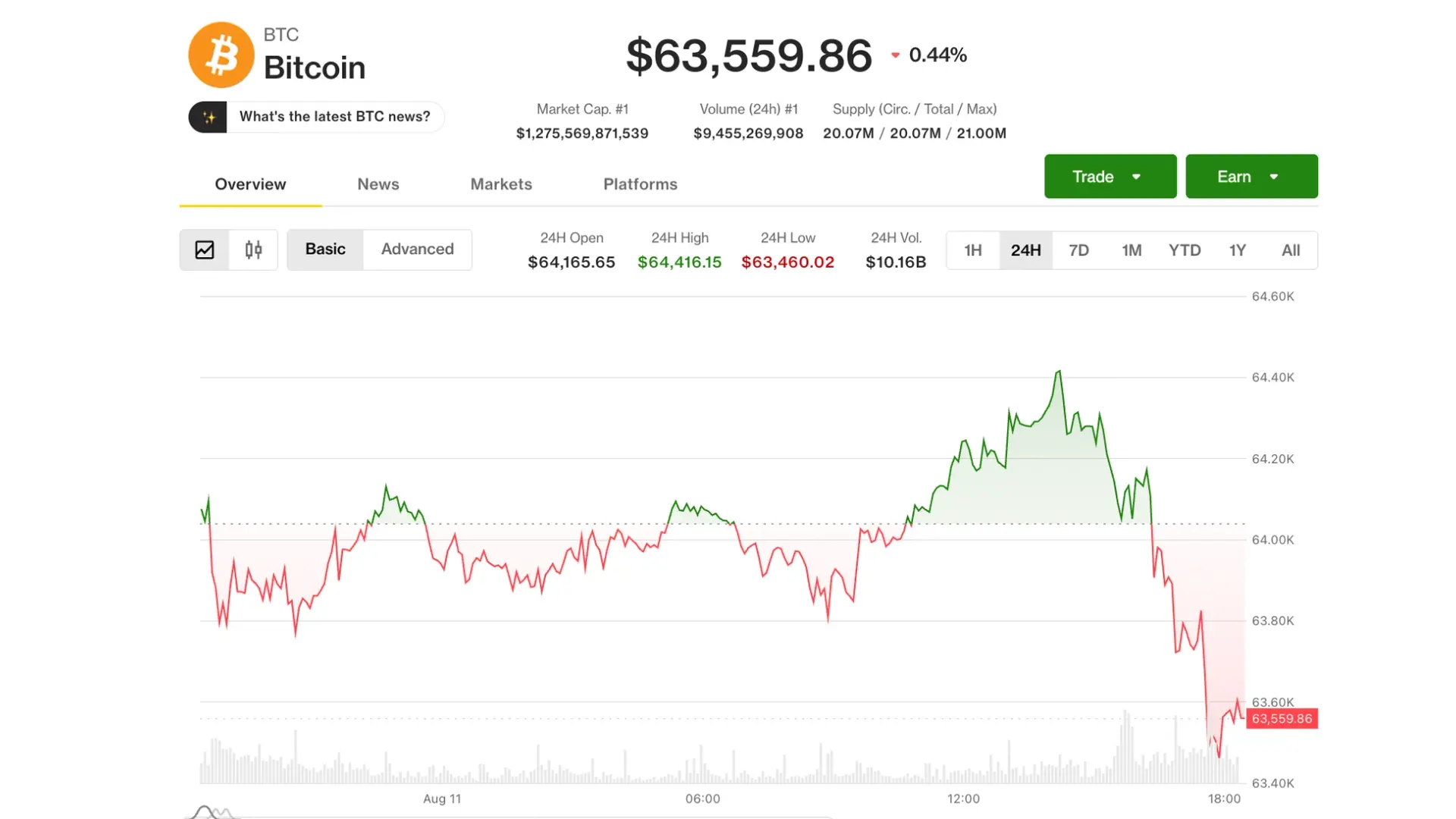
Bitcoin fell to $63,500 on Tuesday, while AI infrastructure provider CoreWeave jumped 9% in after-hours trading after reporting a second-quarter revenue beat and a backlog that surged past $100 billion. The mixed market action came as investors awaited a key U.S. inflation report scheduled for Wednesday that could influence the Federal Reserve's monetary policy path. Crypto traded in a tight range as summer liquidity remained thin, while equities and gold pulled back from recent levels.
CoreWeave's results underscored the unrelenting demand for computing capacity, especially for AI workloads. The company said revenue more than doubled to $2.58 billion from $1.21 billion a year earlier, slightly above the $2.56 billion analysts had expected. Its revenue backlog reached roughly $104 billion at the end of June, and CoreWeave noted that figure does not include more than $25 billion of new customer commitments added early in the third quarter. Operating expenses, however, more than doubled to $2.62 billion, while the company posted a $626 million net loss. CoreWeave has been racing to add infrastructure, expanding active power by nearly 500 megawatts to 1.5 gigawatts during the quarter, with contracted power reaching about 3.7 gigawatts.
The significance of CoreWeave's backlog
The backlog figure is closely watched because it represents contracted future revenue, offering visibility into the sustainability of AI infrastructure spending. Crossing the $100 billion threshold signals that enterprise demand for AI compute remains robust even as some investors worry about a potential bubble. CoreWeave's active power expansion of 500 megawatts in a single quarter illustrates the pace at which AI data centers are being built, but it also explains the surge in operating expenses and the continued net loss. The company is prioritizing growth over profitability, a trade-off that Wall Street has generally accepted for AI infrastructure names, as evidenced by the 9% after-hours share gain.
Stock market and gold pull back
Major U.S. stock indexes ended Tuesday modestly lower. The broad-market S&P 500 declined a little over 0.3%, while the tech-heavy Nasdaq Composite fell 0.6%. Gold also reversed from a two-month high above $4,400 an ounce, turning its early-day gains into a 0.5% loss. The retreat in both stocks and gold suggests investors were de-risking ahead of the inflation report, which could shape expectations for Federal Reserve policy. Adding to the macro picture, the U.S. Strategic Petroleum Reserve has fallen to around 300 million barrels, its lowest level in 40 years, according to a Bloomberg analyst, as the US-Iran conflict continues and uncertainty surrounds the Strait of Hormuz. West Texas Intermediate crude oil was up 0.2%, trading at around $82.50 a barrel.
Wednesday's CPI report: the next catalyst
Economists expect headline CPI to rise 0.1% from June and 3.4% from a year earlier, while core CPI, which strips out food and energy, is forecast to increase 0.2% on the month and 2.5% year over year. A hotter-than-expected reading could force the Fed to keep rates higher for longer, while a soft print would likely reinforce expectations for a rate cut. The report is also the first major inflation data since Fed Chair Kevin Warsh's inflation-focused press conference, making it particularly significant for market participants.
For bitcoin, Wednesday's CPI could provide a spark that moves the price out of its narrow range between $62,000 and $66,000. "Conviction is thin on both sides as summer illiquidity reigns supreme with attention focused on AI," said Jeff Anderson, managing partner at STS Digital. Implied volatility has fallen to rare low levels, leaving the market primed for a larger move if bitcoin breaks either end of the range. Anderson added that the CPI report is the next test for the asset class.
Bitcoin price action and miner volatility
Bitcoin slipped 1.6% during the U.S. session below $63,500, hitting its weakest price in a week as crypto continued to consolidate in quiet summer trading. Zooming out, the largest cryptocurrency has been trading sideways in a tight channel between $67,000 and $58,000 for more than two months. The broad-market CoinDesk 20 Index was 0.6% lower over the past 24 hours, with Cardano's ADA and Uniswap's UNI dragging the index lower.
In the mining sector, Riot Platforms' deal with AI developer Anthropic sparked a temporary bounce in data center stocks earlier in the day. Riot gave up almost all of its 20% advance, holding onto a 2.8% gain. Miners that have pivoted into AI compute, such as Hut 8, Cipher Mining, and TeraWulf, were among the best performers in the sector, up 4% to 6%, but all retreated from session highs. Earlier in the session, Riot Platforms was up 8%, Cipher Mining had gained 11%, TeraWulf was up 8%, and Galaxy Digital had risen 5%. The volatility in these names reflects the market's sensitivity to AI-related catalysts, as miners increasingly reposition themselves as data center operators.
Treasury yields and stablecoin growth stall
Rising U.S. Treasury yields are putting the brakes on stablecoin growth, according to an analysis by Re7 Capital. Stablecoin supply has declined in recent months, and Re7 attributes this to the returns investors can earn onchain compared with U.S. government debt. With the 10-year Treasury yield pushing toward 5%, decentralized finance has a tougher time competing for capital. Stablecoin market capitalization has fallen about $10 billion since May, with July showing the largest monthly decline since 2022.
The relationship also worked in crypto's favor after the 10-year yield peaked near 5% in October 2023 and began falling. Stablecoin supply started a sustained expansion soon after. Now, inflation concerns tied to the Iran conflict have pushed yields higher again, stalling stablecoin growth. Re7 says it expects that pressure to ease if Treasury yields retreat. Lower yields would make DeFi returns more competitive again, potentially drawing liquidity back onchain and restarting stablecoin growth.
Anthropic to watermark AI content
Anthropic said it will mark AI-generated text and files produced by its Claude models, putting into practice its commitments under the EU AI Act's Code of Practice on transparency. Claude models launched in the EU on or after August 2, 2026 will support machine-readable marking from day one. Generated text will carry embedded watermarks, and generated files will include digitally signed provenance metadata where supported, tracing content back to its AI origin.
The marks will apply across Anthropic's products, including its API, the Claude app, Claude Code, Cowork, and Tag, and everywhere Claude is offered worldwide, not just in the EU. The company noted that some platforms and features may not support every marking type. Anthropic also said it will help users and third parties detect the marks, as the Code requires, with technical documentation to follow. Models launched before August 2 fall under a transition period, and Anthropic is working to add marking support to those as well.
Corporate crypto champions are leaving for AI
Bitcoin's recent slide may be connected to the corporations that once championed crypto now turning their attention to AI, according to Alex Kuptsikevich, chief market analyst at FxPro. Bitcoin slipped 2% to about $64,200 on Monday, dragged down less by any single catalyst than by the companies that once gave crypto institutional cover. These include Strategy-led holders and miners like MARA, which have spent the past two years rebranding themselves around AI data centers.
Institutional money is now selling bitcoin to build liquidity or rotating into that trade, Kuptsikevich said. With corporate enthusiasm draining, the risk is that bitcoin long-position liquidation accelerates over the coming weeks. Corporations joined crypto when it flattered their image, the reverse of the stock market, where retail usually arrives last and takes the losses. As those companies leave, Kuptsikevich argues, they hand crypto back to the retail base that built it, returning bitcoin to its ideological roots even if the exit stings on the way out.
Bitcoin is currently sitting just above its 50-day moving average, which has traded nearly flat for three weeks. This creates a standoff between sellers distributing and buyers absorbing. Whether that line holds could be the key technical battleground in the coming sessions, as the market awaits Wednesday's inflation data for a potential trigger.
Source: Coindesk News