

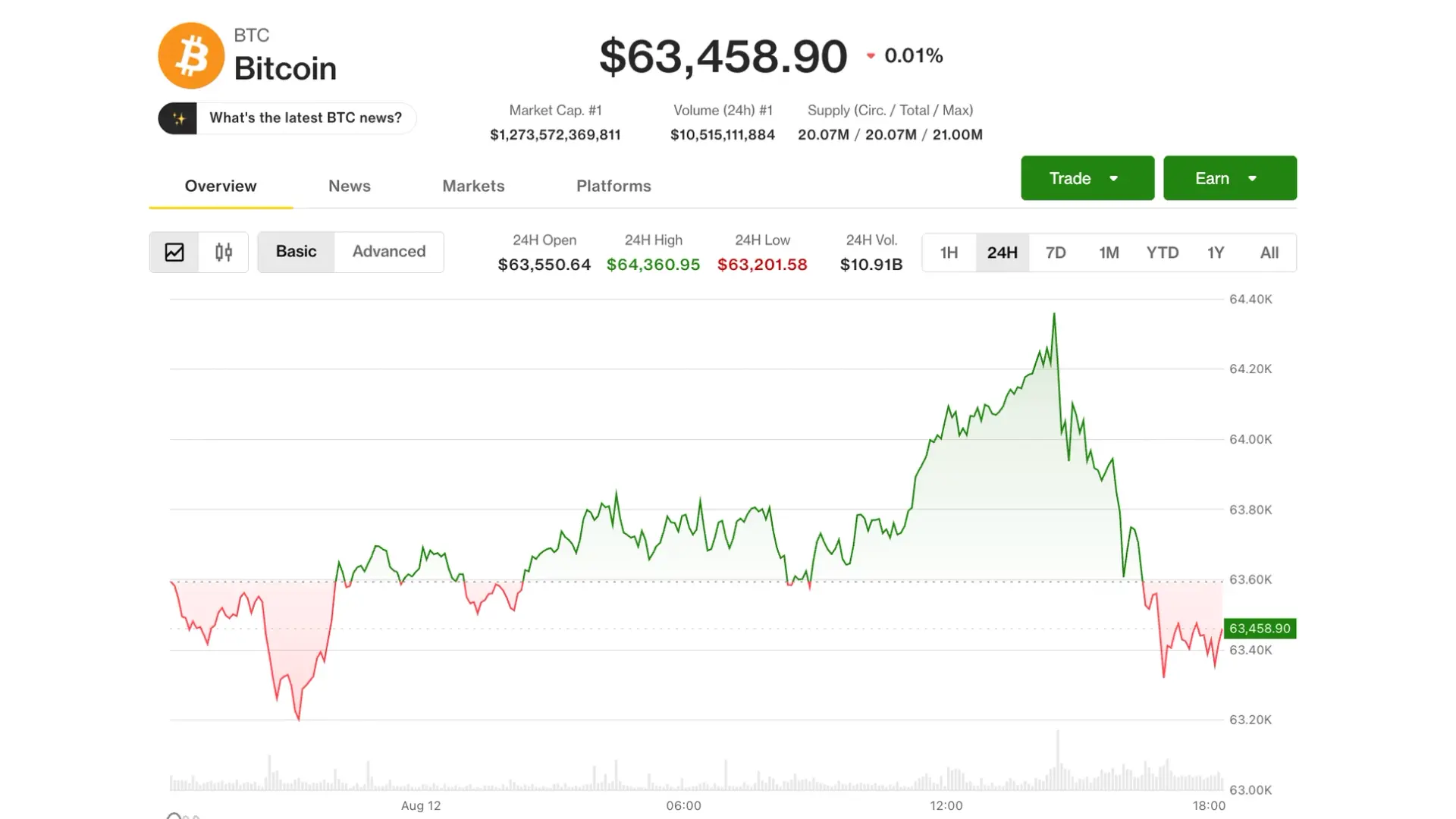
U.S. stocks finished higher Wednesday, fueled by a surge in AI infrastructure names, while bitcoin slipped below $64,000 as inflation data met expectations. The S&P 500 rose 0.3% to close near record highs, and the tech-heavy Nasdaq gained 0.7%, with AI-related companies leading the charge.
Dell Technologies jumped 9.7% to a record closing high of $484, driven by demand for servers and computing infrastructure used to run AI workloads. AI cloud provider Nebius extended its rally to 35%, while fellow neocloud CoreWeave held onto a roughly 20% daily gain. The moves came after a wave of strong quarterly earnings from companies tied to the AI buildout.
AI Infrastructure Earnings Power Market Gains
WhiteFiber and Nebius both saw shares jump around 15% after reporting robust Q2 results. WhiteFiber's revenue rose 54% to $28.8 million, supported by initial billing at its flagship North Carolina data center, NC-1, which has 40 megawatts contracted and potential expansion to 300 megawatts. Nebius reported revenue of $582.3 million, a 454% surge year over year, while adjusted EBITDA swung to $236.2 million. Investors welcomed accelerating AI demand, new contracts, and expanding capacity, even as both companies continued to post net losses and heavy capital spending.
CoreWeave also impressed after hours, surging 16% on booming AI-compute demand. Super Micro rallied 7.6% after issuing a revenue forecast that topped the highest analyst estimates. These results lifted Nasdaq 100 futures earlier in the day and helped push Asian markets higher, with Korea's Kospi jumping 4% as Samsung and SK Hynix each rose about 6%.
The strength in AI infrastructure names reflects a broader trend: companies building the physical backbone of artificial intelligence are seeing accelerating revenue growth and expanded contracts, even as they spend heavily on data centers and equipment. Investors appear willing to look past near-term losses in favor of the long-term opportunity presented by the AI boom.
Inflation Matches Estimates, Fed Rate Hike Odds Waver
The bigger market event on Wednesday was the release of July's Consumer Price Index (CPI), which matched economists' forecasts. Headline CPI rose 0.1% monthly and 3.4% annually, while core CPI, which excludes food and energy, increased 0.2% monthly and 2.5% yearly. The data landed as markets were split on what the Federal Reserve might do at its September meeting.
Following the report, markets assigned a 44% chance of a September Fed rate hike, down from pre-report expectations. The shift reflected softer employment data from last week, which had already cut rate-hike odds. A month ago, market participants saw only a 30% chance of a pause versus 70% odds for hiking rates, according to CME FedWatch. Now the odds are nearly even, with roughly 60% pricing no change and 40% pricing a 25 basis-point hike.
Analysts said the in-line CPI avoided the upside surprise that could have rattled risk assets, but inflation remains sticky. Headline inflation at 3.4% is well above the Fed's target, and energy prices are nearly 15% higher than a year ago, noted Daniela Hathorn, senior analyst at Capital.com. That should keep inflation front and center after Fed Chair Kevin Warsh stressed the need to prevent elevated prices from damaging the economy.
For crypto, the report took an immediate inflation shock off the table without offering much fuel for a breakout. Ryan Lee, chief analyst at Bitget Research, said the print "neither forces a hawkish re-pricing nor delivers a clear dovish catalyst," leaving bitcoin traders to focus on ETF flows, liquidity, and derivatives positioning while awaiting Jackson Hole and more inflation data. Iggy Ioppe, CIO at Theo, argued that keeping rates unchanged still amounts to effective easing given current inflation and labor-market conditions and should support risk assets over the medium term.
Both analysts pointed to Thursday's Producer Price Index (PPI) report as the next test for inflation. A hotter-than-expected PPI reading could reignite rate-hike fears and pressure risk assets, while a soft print would further cement expectations that the Fed will hold rates steady.
Bitcoin Dips Below $64,000, Altcoins Mixed
Bitcoin gave up early-day gains during the U.S. session, sliding toward the lower end of its tight trading range. At midday, it traded at $63,350, largely flat over the past 24 hours but down 1.6% from session highs ahead of the CPI report. BTC has been trading in a narrow band between $62,000 and $66,000 for the past five weeks, and Wednesday's inflation data did not provide enough fuel for a breakout in either direction.
By the close, bitcoin was churning around $63,400, little changed over 24 hours. The price action underscored the market's indecision as traders weighed in-line inflation against an uncertain Fed path and ongoing geopolitical risks.
Among larger cryptocurrencies, Hyperliquid's native token (HYPE) and Near Protocol's NEAR stood out with gains of more than 4%, while Uniswap's UNI fell 5%. XRP teetered on the brink of falling below the $1 level, which has been holding since November 2024. The mixed performance reflected a lack of directional conviction across the digital asset market.
Bitcoin's failure to break higher despite positive AI-related risk sentiment suggests that crypto traders are waiting for clearer signals on monetary policy. The upcoming PPI report, along with the Federal Reserve's Jackson Hole symposium, could provide the next catalyst.
Tokenization Stocks Rally Ahead of SEC Meeting
Stocks tied to the tokenization theme were among Wednesday's standout performers. Figure Technology Solutions jumped nearly 9%, and Securitize gained 7.4% ahead of quarterly results from both companies. The moves came ahead of a potentially important regulatory development: the SEC is scheduled to hold an open meeting Friday as it prepares to propose its first formal rules for crypto businesses.
Those rules could have direct implications for tokenization. Bloomberg reported Tuesday that the SEC may soon propose an "innovation exemption" for trading tokenized securities, putting companies including Figure and Securitize in focus heading into Friday. An exemption could open the door for broader adoption of blockchain-based securities, boosting the business outlook for tokenization firms.
Investors are betting that a favorable regulatory framework could accelerate growth in the sector, even as the companies themselves report mixed financial results.
BitGo, Securitize Report Quarterly Results
BitGo, the crypto custodian, swung to a loss in the second quarter even as revenue and institutional client activity grew. Revenue rose 80% from a year ago to $4.3 billion, driven mainly by digital asset sales. The company posted a $19 million net loss, compared with $38.3 million of net income a year earlier. Adjusted EBITDA swung to a $4.2 million loss from positive $3 million. BitGo also announced that CFO Ed Reginelli will leave his role during the coming quarter, though he will stay on to help with the transition.
The company's client count grew 26% to 5,833, while normalized assets on the platform increased 31% to $65.2 billion. BitGo authorized up to $50 million in share buybacks and said cost cuts should generate about $15 million in annualized cash savings. Despite the operational growth, shares were 5% lower after the report.
Securitize, the tokenization firm best known for issuing BlackRock's tokenized money market fund BUIDL, reported lower revenue and a wider loss for the second quarter even as activity across its platform picked up. Average tokenized assets under management hit a record $4.3 billion, up 16% from a year ago, while transaction volume jumped 147% to $5.3 billion. Revenue slipped 5% to $14.4 million, and the company posted a $21.7 million net loss, or $2.37 per share. Adjusted EBITDA swung to a $5.5 million loss from positive adjusted EBITDA of $1.8 million a year earlier.
Securitize's fund-services business oversaw 663 active funds and $24.3 billion in assets under administration, the latter down about 20%. Shares were 1.3% lower following the results, paring some earlier gains.
Bitcoin Transfer by Metaplanet Not a Sale
On-chain data firm Arkham reported that Metaplanet shifted 3,881 BTC, worth about $247 million, across several transactions over three hours on Wednesday. The move went from the company's cold wallets to new addresses it also controls, not to an exchange. Transfers to fresh self-custody wallets do not add to tradable supply the way deposits to an exchange do, so on their own they do not represent selling.
Metaplanet has done this before. It moved nearly 5,000 BTC in March in the same pattern—test transactions followed by larger amounts into new wallets—and analysts then read it as internal custody reshuffling rather than distribution. Wednesday's on-chain data pointed to a similar conclusion.
Metaplanet bought its roughly 43,000 BTC at an average of about $96,000, so with bitcoin near $63,600, the company is sitting on an unrealized loss of about $1.4 billion, down 34%. Despite the paper losses, Metaplanet has been one of the most aggressive corporate buyers since April 2024, with a stated target of accumulating 210,000 BTC.
Dollar Index at Key Support, Metals Rise
The Dollar Index, which tracks the greenback against a basket of major currencies, was trading right at the support of a bullish trendline that has guided its rise from the January low of 95.55. A bounce from this level would signal a continuation of the rally, while a decisive break below it would point to a potential reversal. Wednesday's CPI data was seen as the key catalyst for the dollar's next move, with a hotter-than-expected core reading potentially sparking a meaningful rebound.
Metals were climbing ahead of the inflation report. Gold traded at $4,420, up more than 1% over the past 24 hours and 7% this month. Silver rose above $66, gaining more than 2.5% over the past 24 hours and 12% this month. Bitcoin also climbed above $64,000 in early trading, up less than 1% over 24 hours, though it later gave back those gains.
Traditional markets showed resilience, with gold holding above $4,400 an ounce near two-month highs. The combination of strong AI earnings, in-line inflation, and ongoing geopolitical tensions created a mixed but generally supportive environment for risk assets. Investors now look ahead to the PPI report and the Fed's Jackson Hole symposium for further direction.
Source: Coindesk News