

Key facts
- A homelab owner who thought the setup was well patched asked AI coding assistants to audit it and found multiple critical vulnerabilities.
- The audit found PHP bugs in a self-hosted RSS reader and read-it-later apps, exposing them to PHP2Shell-style attacks.
- Brotli compression flaws appeared in unpacked packages on four Raspberry Pi devices.
- Compromised digital certificates from eMudhra were still trusted by the homelab VPN.
- Unpatched Node.js runtimes were present in several other services.
- The vulnerabilities mirror a wider wave of critical bugs in PHP, Brotli, Node.js, and certificate infrastructure that AI models helped uncover.
- Patching remains a work in progress, with AI agents filing to-do items and one decade-old Raspberry Pi 3 offline after a failed reboot.
- The episode shows that AI is accelerating both vulnerability discovery and remediation, while human review and disciplined patch management remain essential.
When a homelab owner began a routine security review, the expectation was simple: years of patching, updating, and self-hosting experience had produced a reasonably hardened setup. Instead, an AI-assisted audit found bugs in almost every layer of the environment. The discovery was not the result of a rogue AI experiment or an exotic attack. It came from asking advanced coding assistants to look for known vulnerability patterns in code, packages, certificates, and running services.
The findings arrived during a broader moment of unease about internet infrastructure. Over a short period, critical vulnerabilities were disclosed in PHP, a scripting language used by a large share of websites; Brotli, a compression format common on web servers; and Node.js, a runtime embedded in many web applications. Separately, a certificate distributor was found to have issued compromised credentials. Each of those components is deeply embedded in modern web plumbing, so the disclosures felt less like isolated bugs and more like a series of structural cracks appearing at once.
A wave of critical bugs surfaces at once
PHP is one of the most widely deployed server-side languages on the web. Estimates often place its use at roughly 70 percent of websites, a figure that reflects its long history in content management systems, forums, blogs, and custom web apps. When a critical PHP vulnerability emerges, the blast radius is not limited to a single vendor or platform. It reaches into shared hosting environments, self-hosted applications, legacy installations, and small projects that may not have dedicated security teams.
Brotli plays a different but equally important role. Web servers use it to compress files before sending them to browsers, reducing bandwidth and speeding up page loads. A flaw in a compression library can be easy to overlook because it sits beneath the application layer. Developers and administrators tend to focus on the visible software, not the packaging and transport mechanisms underneath. That is exactly what makes such bugs valuable to attackers and dangerous to defenders.
Node.js has become a default runtime for many web apps, APIs, and internal tools. Its package ecosystem is vast, and applications often depend on layers of third-party modules. An unpatched Node.js runtime can remain hidden in a container, a service manager, or a forgotten project directory for months. The same is true of certificate infrastructure. Digital certificates are meant to verify identity and establish trust, so a compromised certificate distributor undermines a foundational assumption: that the party on the other end of a connection is who it claims to be.
The timing of these disclosures made them feel sudden, but the vulnerabilities themselves were not necessarily new. Many had been hidden for months or years. What changed was the ability of advanced AI models to analyze large codebases, compare patterns, and identify weaknesses at scale. The bugs did not all appear at once. The tools capable of finding them did. That distinction matters because it explains why a quiet period can suddenly turn into a flood of urgent advisories.
Inside the homelab audit
The homelab in question was not a major data center. It was a personal setup: self-hosted services, Raspberry Pi devices, a VPN, and a collection of applications that had accumulated over time. The owner had patched regularly and assumed the environment was in good shape. Two AI coding assistants were asked to crawl through the setup and inspect it for known vulnerability patterns. A separate conversational AI agent later acted as an auditor, moving from one code repository to the next and checking whether fixes had been applied correctly.
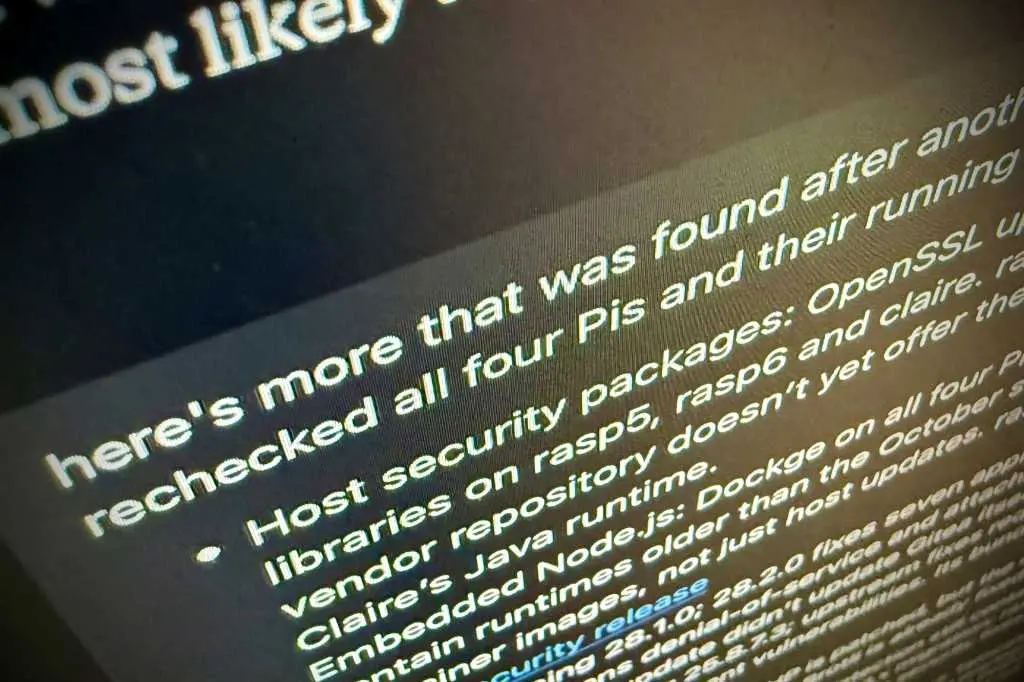
The results were sobering. The PHP vulnerability was present in a self-hosted RSS reader and a read-it-later application. Both were exposed to PHP2Shell-style attacks, a class of exploitation that can turn a web-facing PHP flaw into remote code execution. The Brotli bug appeared in unpacked packages on all four Raspberry Pi devices. Compromised eMudhra certificates were still trusted by the homelab VPN. Unpatched Node.js runtimes were lurking in several other services.
None of those findings required a sophisticated adversary to discover. They required a systematic review. That is the uncomfortable lesson for anyone who runs a small network, a lab, or a set of self-hosted tools. Security is not a binary state that can be achieved once and then forgotten. It is a moving inventory of software versions, configuration choices, trust relationships, and operational assumptions. AI did not create the vulnerabilities. It made them visible faster than the owner could have found them manually.
Patching became an ongoing project rather than a single task. The AI assistants filed one to-do item after another. Some fixes were straightforward package updates. Others required configuration changes, certificate replacement, or service restarts. One system, a Raspberry Pi 3 that was more than a decade old, went down after a failed reboot to install patched operating system packages. The device had been useful, but its age and limited resources made it a fragile part of the recovery process. A security cleanup had turned into an availability problem.
Why homelabs are a security blind spot
Homelabs occupy an awkward space between hobby projects and production infrastructure. They often run on consumer hardware, use a mix of containerized and bare-metal services, and depend on documentation that exists mainly in the owner’s memory. Some services are exposed to the internet through a VPN or reverse proxy. Others are meant to be internal but are reachable from more places than expected. Updates are applied when time allows, not according to a formal service-level agreement.
That makes homelabs an ideal test case for AI-assisted security review. A human administrator may know the broad shape of the environment but forget which container is still running an old base image or which application bundles a compression library with a known flaw. AI tools can scan repositories, manifests, lockfiles, and configuration files in parallel. They can compare dependency versions against advisories, flag suspicious certificate trust settings, and produce a prioritized list of remediation steps.
The catch is that AI tools can also be wrong. They may report false positives, miss context-specific risks, or suggest a patch that breaks compatibility. In a homelab, those errors are annoying. In a business environment, they can be costly. The audit is therefore best understood as an accelerant, not a replacement for judgment. The owner still has to verify each finding, decide whether the service is worth keeping, and test the fix before trusting it.
Certificate trust is an especially sharp example. A compromised certificate authority or distributor can undermine encrypted connections even when the software on both ends is fully patched. The homelab VPN trusted certificates that should have been removed. That kind of issue is easy to overlook because it does not look like a traditional software bug. It lives in trust stores, configuration files, and the assumptions that make secure connections possible. AI can help find it, but only if the review includes certificates as part of the attack surface.
The AI-driven vulnerability discovery cycle
The broader web is now caught in a loop that is likely to define the next phase of security operations. AI models find vulnerabilities faster than humans can triage them. Vendors issue patches. Administrators race to deploy those patches. AI models then find the next batch, including flaws in the patching process itself. The cycle is not purely destructive. It also creates pressure to improve inventory management, software supply chain visibility, and automated testing.
For small-scale operators, the practical lesson is to treat AI as an auditor that never gets tired but always needs supervision. It can inspect a self-hosted application for dangerous patterns, check whether a package manager has pinned a vulnerable dependency, and compare certificate stores against expected values. It can also generate a remediation plan and track whether each item is complete. What it cannot do is take responsibility for the trade-offs. Removing a service may be safer than patching it, but only the owner knows whether that service matters.
The wave of PHP, Brotli, Node.js, and certificate problems also shows how interconnected modern infrastructure has become. A bug in a compression library can affect servers that never directly use the library in application code. A flaw in a scripting language can reach into plugins, themes, and custom extensions. A compromised certificate can weaken trust for services that appear unrelated. Security teams and homelab owners alike are being forced to think in terms of dependency chains rather than individual products.
System administrators deserve credit for keeping the internet largely functional during the disclosures. Many worked through urgent patching cycles, replaced certificates, and rebuilt services under time pressure. The homelab owner’s experience was a smaller version of the same struggle: a long list of fixes, a few broken systems, and the realization that the environment was less secure than it appeared. The fact that the setup was not mission-critical made the mistakes survivable. It did not make them harmless.
What the audit reveals about modern patching
One of the clearest takeaways is that patching is not just about installing updates. It is about knowing what is running, where it came from, and what it trusts. A software bill of materials helps, but it is only useful if it is accurate and current. Certificate inventories matter, but they decay quickly if no one reviews them. Package managers can pin versions for stability, but pinned versions can also hide known vulnerabilities for years.
AI-assisted audits can make those problems more visible, especially in environments that lack a dedicated security team. They can read configuration files, compare dependency trees, and produce a report that a human can act on. They can also help with the least glamorous part of security: follow-through. A to-do list generated by an AI agent is not a fix, but it can keep a long remediation project from disappearing into a notes app.
The homelab remains a work in progress. Some services have been patched. Others are waiting for testing. The decade-old Raspberry Pi 3 is still offline. The AI assistants continue to file tasks, and the auditor agent continues to check repositories for new problems. The experience has not produced a clean ending or a perfect state of security. It has produced a more accurate picture of how much hidden risk can accumulate in a small, familiar system.
That picture is likely to become more common as AI models improve at finding vulnerabilities across code, packages, and infrastructure. The same technology that exposed the homelab’s bugs will be used to fix them, and then to look for more. The loop will continue around and around, with each pass revealing something that was previously invisible.
Source: PCWorld News