

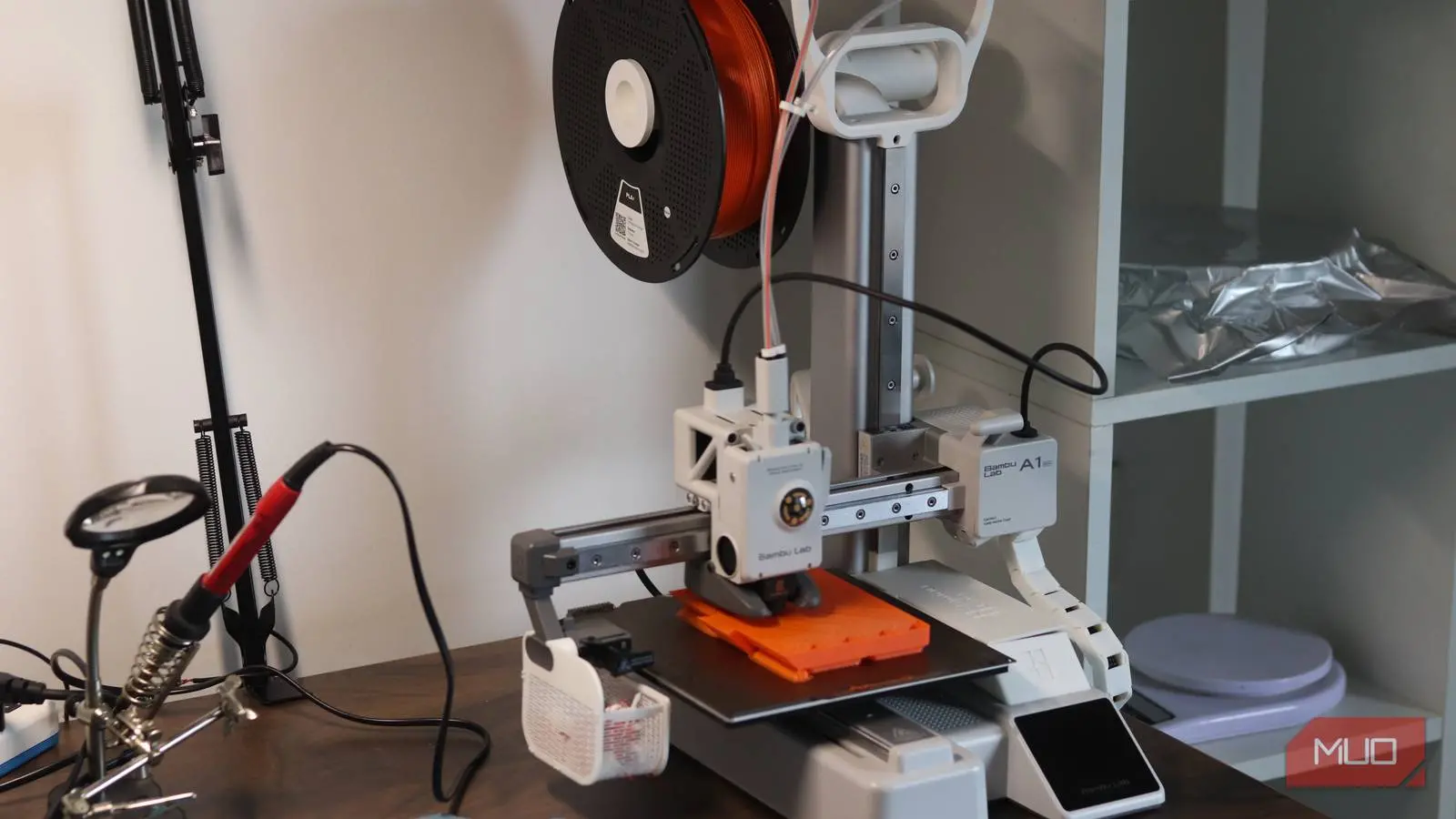
For years, I told myself that 3D printing was not for me. It was too noisy, too messy, too slow, and too demanding. I had seen the inside of a 3D printer up close and knew what could go wrong. But when I finally bought a modern machine in 2026, almost every assumption I had built up over nearly a decade turned out to be outdated. The reality of today's 3D printers is very different from the machines I repaired back in 2017.
The printer was never the problem
Noise, space and disruption: overestimated
My first job out of high school involved repairing and maintaining two 3D printers. They were Wanhao Duplicator 3 machines—large, heavy, nearly industrial, with a small print bed and a big enclosure. I learned to fix them and keep them running, but they also taught me to expect trouble. Every print seemed to require careful bed leveling, and I often had to use a sheet of paper to estimate the gap between the nozzle and the bed. It was rarely accurate enough. The noise was another issue: the printers whirred, clicked, and hummed loudly enough to make my workspace uncomfortable.
Those memories shaped my hesitation for years. I wanted a printer that could sit on my electronics workbench, right next to the desk where I do hardware projects. Space was tight. I was convinced that any printer would dominate the room and demand constant attention. When I finally bought a Bambu Lab A1 Mini, the machine defied those expectations. It has a tiny footprint, a clean design, and quiet motors. Apart from a cooling fan, I can barely hear it running. I now run print jobs all day while sitting barely a meter away, and it does not disturb me at all.
Speed mattered less than I expected
Long print times stopped mattering when the printer could work unattended
I had two fears about print speed. The first was that every print would take an entire day. I remembered old printers moving slowly and requiring constant babysitting. The A1 Mini changed that almost immediately. It printed a standard Benchy test boat in about 20 minutes at default settings. Real-world functional prints—brackets, enclosures, organizers, mounts—completed in a fraction of the time older machines needed. Most prints now feel like background tasks, not events.
My second fear was attention. I thought a print would demand that I stand nearby, watch the first layers, and intervene whenever something went wrong. Modern printers have eliminated that concern. The bed levels itself automatically before every print. Filament runout detection pauses the job if the material runs out. A built-in camera lets me check progress from my phone using the manufacturer's app. With a little extra setup, I can integrate the printer into a smart home dashboard. I have started prints while hundreds of kilometers away from my printer and returned home to a perfect object waiting on the bed.
This shift is not just about hardware. Modern slicer software, profiles for common filaments, and cloud-connected interfaces have made the entire workflow more predictable. Once the machine is set up and the filament is tuned, printing becomes a background process. It is still possible to have failures, but they are the exception rather than the rule.
Maintenance turned out to be mostly a myth
Modern printers require far less tinkering than their reputation suggests
Beyond time, I expected maintenance to eat into my schedule. Back in the day, I considered myself lucky if I got through a full day of printing without unclogging a nozzle or re-leveling the bed. I budgeted for bed calibration, nozzle clogs, belt tension checks, and all the other little chores that seemed inseparable from the hobby. The reality has been far simpler.
In the first 134 hours of total printing time with my A1 Mini, the only maintenance I performed was calibrating my filament profiles. Even that was not strictly necessary, because the generic PLA profiles worked well with several different brands of filament. I have kept the build plate clean and occasionally checked the rails, but the machine has not required constant tinkering. This is a major departure from the experience that made me hesitate in the first place.
The one area where I would temper expectations is multi-color printing. I did not buy the AMS or AMS Lite unit because of the waste it produces. Multi-color printing adds significantly more time and filament to a print, and it generates a lot of purge material. For my everyday prints—custom ESP32 enclosures, mounts, cosmetic parts, replacement brackets, and organizers—single-color printing has been remarkably low friction. If someone's main goal is multicolor, the convenience comes with an environmental and time cost that should not be ignored.
The biggest mistake was waiting so long
I should have bought a 3D printer years earlier instead of overthinking it
When I finally bought my printer, I realized how much the industry has evolved in just a few years. The Bambu Lab A1 Mini is an excellent machine, but it is not alone. Modern printers from Creality, Elegoo, Prusa, and others have moved toward the same philosophy: configure once, trust the defaults, and let it work. These machines no longer behave like fragile hobbyist kits. They behave more like home appliances. With basic maintenance, such as cleaning the build plate and lubing the rails, they run just fine.
Part of my hesitation came from a decade-old mental image of 3D printing. I had not updated that image to reflect the progress in auto bed leveling, direct-drive extruders, improved hot ends, better slicers, and smart features. The lessons I learned in 2017 were still true for the machines of that era, but they are no longer true for the machines of today.
If your hesitation is like mine was—rooted in concerns about time, noise, space, or maintenance—it is worth revisiting those assumptions. Modern 3D printers address both sides of the time equation: they print faster, and they require far less attention while doing so. They are quiet enough to live in a shared workspace, small enough to sit on a workbench, and reliable enough to run without supervision. The technology has matured to the point where it is genuinely approachable for anyone, not just enthusiasts who enjoy tinkering.
I also discovered that the practical value of a printer goes beyond the objects it creates. Having the ability to design and fabricate custom parts at home changes the way you approach problems. Instead of searching online for a bracket or waiting days for a replacement part, I can model a solution and print it in the time it would take to drive to a store. This makes 3D printing feel less like a hobby and more like an essential tool for anyone working on projects around the house or in a workshop.
Another factor that surprised me was the quality of modern print surfaces. In my early days, getting a print to stick to the bed was an achievement. Now, flexible steel plates with textured coatings make part removal almost effortless. The technology has removed the two biggest frustrations of old printers: adhesion and alignment.
The software side has also improved dramatically. Slicing a model used to be a manual process with a steep learning curve. Today, many printers come with integrated software that automatically selects the right settings based on the filament, layer height, and desired quality. Even beginners can produce good results on their first day.
I am not saying every print will be perfect. There will still be occasional failures, especially if you try exotic materials or complicated models. But the frequency and severity of failures have dropped so much that they no longer justify avoiding the technology. A failed print is now simply an opportunity to adjust a setting, not a reason to spend hours cleaning a clogged nozzle.
In retrospect, the biggest obstacle was not the cost, not the space, and not the learning curve. It was my outdated view of what a 3D printer was like. The machines I repaired in 2017 were transitional products. Today's machines are a different breed, built for a wider audience and designed to eliminate the very problems that made me hesitate. If you are on the fence because of past experience, I would suggest taking a fresh look. The technology has changed, and the reasons to wait have largely disappeared.
I wish I had stopped waiting much sooner. The years I spent imagining problems were years I could have spent designing, printing, and refining useful objects. If there is one lesson from my experience, it is that assumptions based on old hardware do not age well. The best way to understand modern 3D printing is to try it for yourself.
Source: MakeUseOf News