

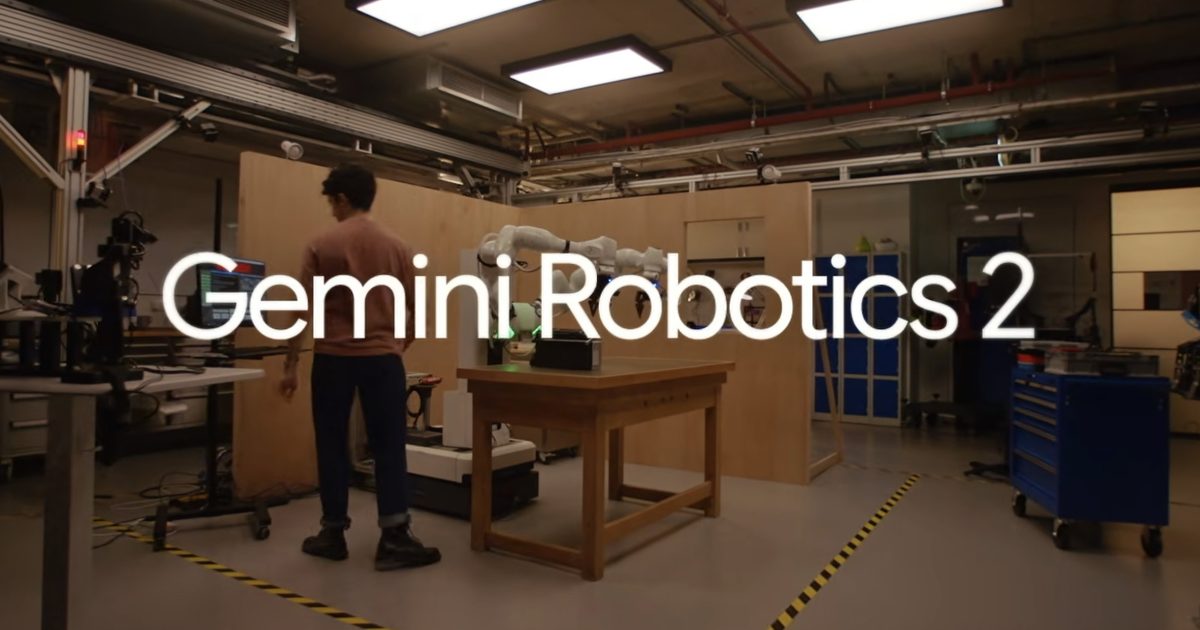
Google DeepMind has unveiled Gemini Robotics 2, a next-generation artificial intelligence system designed to give robots more balance, smarter hands, and the ability to work together. This is a major step beyond traditional robotics, where machines typically follow pre-programmed movements or rely on a human operator controlling them remotely. With Gemini Robotics 2, robots are able to navigate unpredictable situations and adjust their actions in real time.
The model is a successor to Google’s original Gemini Robotics model, which was introduced earlier this year. While the first version focused on helping robots understand and interact with objects in structured settings, the new release expands considerably. Gemini Robotics 2 can control a robot’s entire body, perform complex manual tasks, and even coordinate multiple machines on the same job. In addition, Google is launching a reasoning-focused variant called Gemini Robotics ER 2, along with a new safety benchmark and an on-device version that can adapt to new robot hardware quickly.
From tabletop tasks to whole-body control
One of the most significant improvements in Gemini Robotics 2 is whole-body control. Earlier robotics models from Google were mostly trained to complete tabletop tasks using a robot’s upper body. That limited robots to pick-and-place operations and other constrained settings. The new model controls the entire humanoid, from the feet to the fingertips, allowing robots to move through spaces and interact with objects at different heights and distances.
In one demonstration, Google showed Apptronik’s Apollo 2 robot being asked to place a watering can into a bin located on a bottom shelf. The robot walked over, picked up the watering can, crossed the room, and set it down exactly where it belonged. That kind of task may seem simple for a person, but it is difficult for robots because it requires balancing while walking, gripping an object of a particular shape, navigating around obstacles, and adjusting the arm and torso to place the object at a low height. Whole-body coordination of this kind is essential for robots moving beyond research labs and into homes, hospitals, and warehouses.
Dexterity that feels almost human
The new model also brings noticeably better dexterity. Google has demonstrated Gemini Robotics 2 controlling a five-fingered robotic hand with enough precision to tie a knot, seal a zip-lock bag, or unscrew a light bulb. These tasks demand fine motor control, continuous adjustment, and the ability to apply the right amount of force without damaging the object. This is an area where many robots have historically struggled. Human hands are incredibly complex, with dozens of muscles and sensory receptors that give us feedback as we touch and manipulate objects. Simulating that in a machine requires advanced AI models and highly sensitive hardware.
Gemini Robotics 2 does not only work with advanced anthropomorphic hands. It also works smoothly with simpler two-fingered grippers, which are common in industrial settings. The same model can be used for tasks like packing items, sorting objects, or handling goods on a production line. This flexibility is important because most robots in the real world do not yet have human-like hands. Being able to run the same AI across different types of robot hardware could make the system far more practical for companies that already have existing robotic systems.
A reasoning model that acts as a project manager
Beyond physical control, Google is also introducing Gemini Robotics ER 2, a reasoning model that acts like a project manager for robots. This model is designed to break down complex instructions into smaller steps, keep track of tasks that last several minutes, and help multiple robots coordinate on the same job. For example, if a robot is asked to clean up a room, the reasoning model can plan the order of actions, decide which robot should pick up which object, and monitor progress to ensure everything is completed. This kind of high-level planning is necessary for robots to operate in real environments where tasks are not always clearly structured.
The ER 2 model is also intended to support human-robot collaboration. Instead of just following a single command, it can interpret context and make decisions that align with the user’s goals. This is a meaningful step toward robots that are not just tools but autonomous assistants capable of understanding what needs to be done and how to do it.
On-device adaptation
Another important feature is an on-device version of the model designed for robots without internet access. Many deployments, especially in factories, warehouses, or remote locations, cannot rely on cloud connectivity. The on-device version addresses this limitation. It can adapt to a brand-new robot body in just a few hours using as few as 200 examples. That is notable because, in the past, training a robot to operate with new hardware usually required collecting large amounts of data and fine-tuning for days or weeks. With this system, a robot could be set up for a new role much more quickly, which could accelerate the adoption of robotics across industries.
Safety gets serious attention
Safety is another area where Google is focusing its efforts. The company introduced a new benchmark called ASIMOV-Agentic to test whether robots know when to refuse a risky action or ask a human for help instead. This is an important test because robots in real-world environments will inevitably be asked to do things that could cause harm. A robot that blindly follows commands could injure a person, damage property, or get stuck in an unsafe situation. The benchmark measures not only whether the robot avoids dangerous actions but also whether it communicates its limitations effectively.
Gemini Robotics ER 2 also includes a safety feature that can sense when a person gets too close and bring the robot to a safe stop. This kind of response is critical if robots are to work alongside people in homes and workplaces. Unexpected encounters with humans are one of the hardest challenges in robotics. A robot needs to detect where a person is, estimate the risk of collision, and stop or adjust its movement quickly. Google says this capability is built into the model’s reasoning system, rather than being an external software patch.
Availability and early access
Gemini Robotics ER 2 is already live on Google AI Studio, allowing developers and researchers to experiment with the reasoning model. The other models, including Gemini Robotics 2 and the on-device version, are currently rolling out to early access partners. That means we can expect to see more real-world demonstrations in the coming months as companies begin testing the technology in their own robots.
Google’s announcement comes during a period of rapid progress in embodied AI, the field focused on giving AI systems physical bodies and the ability to act in the world. Advances in large language models and vision models have made it easier for robots to interpret instructions and perceive their surroundings. But there is still a long way to go before robots can handle the full complexity of daily life. Gemini Robotics 2 appears to be a meaningful step in that direction, offering more complete control, better manual ability, and stronger safety mechanisms. As the rollout expands, the impact of this technology could be seen across logistics, healthcare, domestic assistance, and many other areas where robots are expected to become more common.
Source: Digital Trends News