

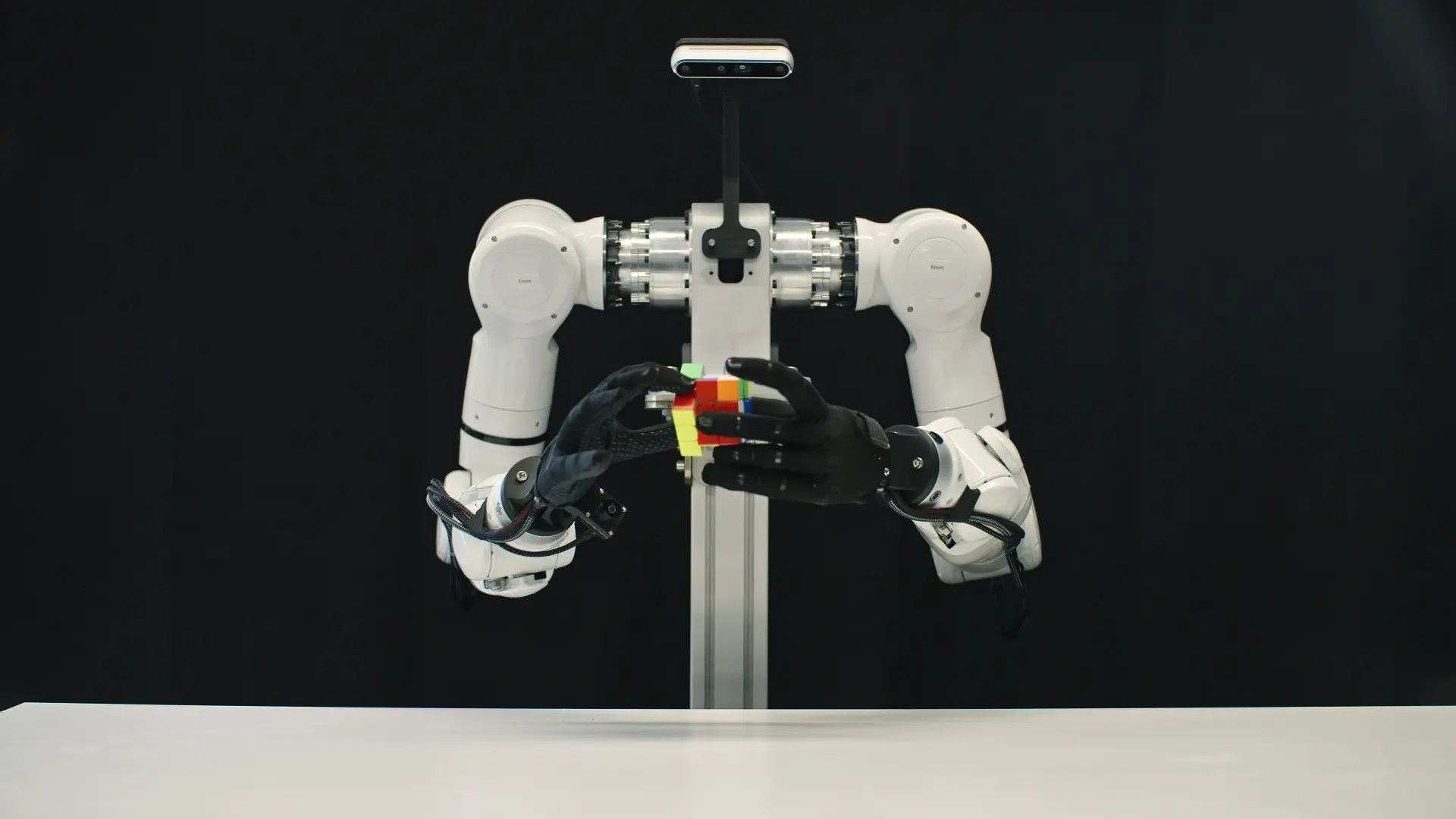
French robotics-focused start-up Genesis AI has released its first foundational model, GENE-26.5, along with a human-like hand built in-house that is capable of carrying out complex tasks such as cooking or solving a Rubik’s Cube. This marks a significant milestone for the company, which completed a $105 million (£77.2 million) seed funding round in July of last year. Co-founder and chief executive Zhou Xian explained that the company started with a focus on a model to power real-world robotics, then built its own hand to have more accurate control over the full stack.
Unlike robotic hands developed by dozens of other companies, which tend to have two or three fingers, the unit from Genesis AI closely resembles a human appendage. This design allows data to be more directly transferred to the device, enabling it to perform tasks that require fine motor skills. The hand’s five-fingered configuration is a deliberate choice, as it mimics the dexterity of a human hand and can be trained using existing human demonstration data.
Genesis AI’s Approach to Robotics
The company’s strategy is rooted in the belief that the most effective way to advance robotic manipulation is to control both the software and hardware. By building the hand in-house, Genesis AI can optimize the integration between the AI model and the physical components. This vertical integration is rare in the robotics industry, where most companies either focus on the AI layer or the hardware, but rarely both.
Genesis AI’s first model, GENE-26.5, is a foundational model trained on a large dataset of human demonstrations and simulated robotic tasks. It is designed to generalize across different tasks, allowing robots to adapt to new environments without extensive retraining. The model’s name, GENE-26.5, likely refers to the number of parameters or a version number, but the company has not disclosed exact specifications.
The Robotic Hand: A Breakthrough in Dexterity
The human-like hand produced by Genesis AI is constructed from lightweight materials and includes multiple degrees of freedom in each finger. In demonstration videos, the hand is shown performing tasks that have long been considered challenging for robots, such as preparing a smoothie, playing the piano, and solving a Rubik’s Cube. These tasks require precise force control, tactile feedback, and coordinated movement of multiple joints.
One of the key innovations is the hand’s ability to handle objects of varying shapes and sizes. For example, in the smoothie-making demonstration, the hand can grip a blender bottle, pour ingredients, and press buttons. In the Rubik’s Cube task, it rapidly rotates the cube’s faces with speed and accuracy similar to a human speedcubing expert.
To generate training data for the hand, Genesis AI has created lightweight sensor gloves that can be worn by human workers in fields such as pharmaceuticals and manufacturing. These gloves capture detailed motion and force data, which is then transferred to the AI model. The company acknowledges that workers might be hesitant to help train a potential robotic replacement, but believes that the benefits of improved ergonomics and reduced repetitive strain injuries could offset such concerns.
In addition to glove data, Genesis AI also uses videos of workers carrying out tasks. This multi-modal approach enriches the training dataset, enabling the model to learn from both structured demonstrations and unstructured real-world footage.
Background and Team
Genesis AI was founded by Zhou Xian and Theophile Gervet, who previously worked for France’s Mistral AI, a prominent AI startup. Gervet, now president of Genesis AI, brings deep experience in large language models and generative AI. The company retains a substantial presence in Europe, attributing this to the continent’s large talent base and potential market of industrial customers. The team of 60 people is split roughly evenly between the United States and Europe, with a slightly larger group based in San Carlos, California. The company also has offices in Paris and London.
The seed funding round in July 2024 was co-led by Eclipse and Khosla Ventures, with additional backing from Bpifrance, HSG, former Google CEO Eric Schmidt, telecoms entrepreneur Xavier Niel, MIT Computer Science and Artificial Intelligence Laboratory director Daniela Rus, and Apple distinguished scientist Vladlen Koltun. The involvement of such high-profile investors underscores the potential of Genesis AI’s approach.
From Hand to Full-Body Robot
Genesis AI has announced that it is working to supplement the mechanical hand with a full-body, general-purpose robot. This next stage will involve integrating the hand with a mobile base and an articulated arm, allowing the robot to roam freely and perform tasks in dynamic environments. The company believes that a full-body robot will be able to handle a wider range of industrial and household tasks, from assembly to cleaning.
The development of a full-body robot presents significant engineering challenges. Locomotion, balance, and arm coordination must be seamlessly integrated with the hand’s dexterity. However, Genesis AI’s experience with the hand gives it a head start in understanding the complexities of manipulation.
Industry Context and Competitive Landscape
The field of robotic manipulation has seen rapid advances in recent years. Companies like Boston Dynamics, Figure AI, and Tesla have all developed humanoid robots with varying degrees of dexterity. However, most of these robots still rely on two-fingered grippers or simple parallel jaws. Genesis AI’s five-fingered hand puts it in a unique position, especially for tasks that require delicate touch.
Research in academia, such as DRL (Dactyl) from OpenAI and work at UC Berkeley’s BAIR lab, has also explored high-dexterity manipulation. But commercializing such a hand at scale remains difficult due to cost and reliability issues. Genesis AI aims to address this by optimizing the design for manufacturing and using durable materials.
The company’s focus on Europe is also notable. Europe has a strong tradition in industrial robotics, particularly in automotive manufacturing, but has lagged behind the US and China in AI-driven robotics startups. Genesis AI’s presence in Paris and London could help bridge this gap, especially as European industries seek to automate more complex tasks.
Challenges and Future Outlook
Despite the impressive demos, Genesis AI faces several hurdles. The cost of the hand and the required AI hardware is likely high, making broad adoption challenging in the short term. Moreover, the robustness of the hand beyond controlled demos has yet to be proven in real-world manufacturing environments, where dust, temperature variations, and unexpected forces can cause failures.
Another challenge is data collection with the sensor gloves. Convincing workers to wear the gloves and contribute to training data requires careful ethical considerations and incentives. The company has not disclosed any partnerships with manufacturers for pilot programs, but given the seed funding, such collaborations are likely in the pipeline.
On the technical side, the GENE-26.5 model must demonstrate reliable generalization to new tasks without catastrophic forgetting. The hand’s AI must be able to parse visual input, plan actions, and execute with high precision. Genesis AI claims that the model can learn from both simulated and real data, but the transfer learning gap remains a significant research area.
Broader Implications for AI and Robotics
The release of GENE-26.5 and the robotic hand highlights a trend toward embodied AI, where models are not just trained on text or images but also on physical interactions. This is a crucial step toward robots that can assist humans in homes, hospitals, and factories. If Genesis AI succeeds in creating a cost-effective, dexterous hand, it could accelerate the adoption of robotics in industries like elderly care, food preparation, and specialized manufacturing.
Additionally, the company’s approach to building both the AI model and hardware in-house reflects a growing philosophy in robotics: that breakthroughs require tight integration. This is reminiscent of how Tesla designed its own chips for autonomous driving or how Apple controls both the OS and hardware for its devices. It remains to be seen whether this vertically integrated model can scale profitably in the robotics sector, which typically relies on commodity components and software platforms.
The commitment from leading investors and advisors, including Eric Schmidt and Daniela Rus, adds credibility to Genesis AI’s vision. Rus, who heads the MIT CSAIL lab, has been a pioneer in robot manipulation and dexterous hand design. Her involvement suggests that Genesis AI’s technology aligns with cutting-edge research.
Genesis AI’s next steps will be closely watched by the robotics industry. If the company can deliver on its promise of a full-body robot with the dexterous hand, it could challenge established players and open up new applications for general-purpose robots. For now, the demonstration of a hand that can play the piano and solve a Rubik’s Cube is a compelling proof of concept, but translating that into a reliable product will be the true test of the company’s capabilities.
Source: Silicon UK News