

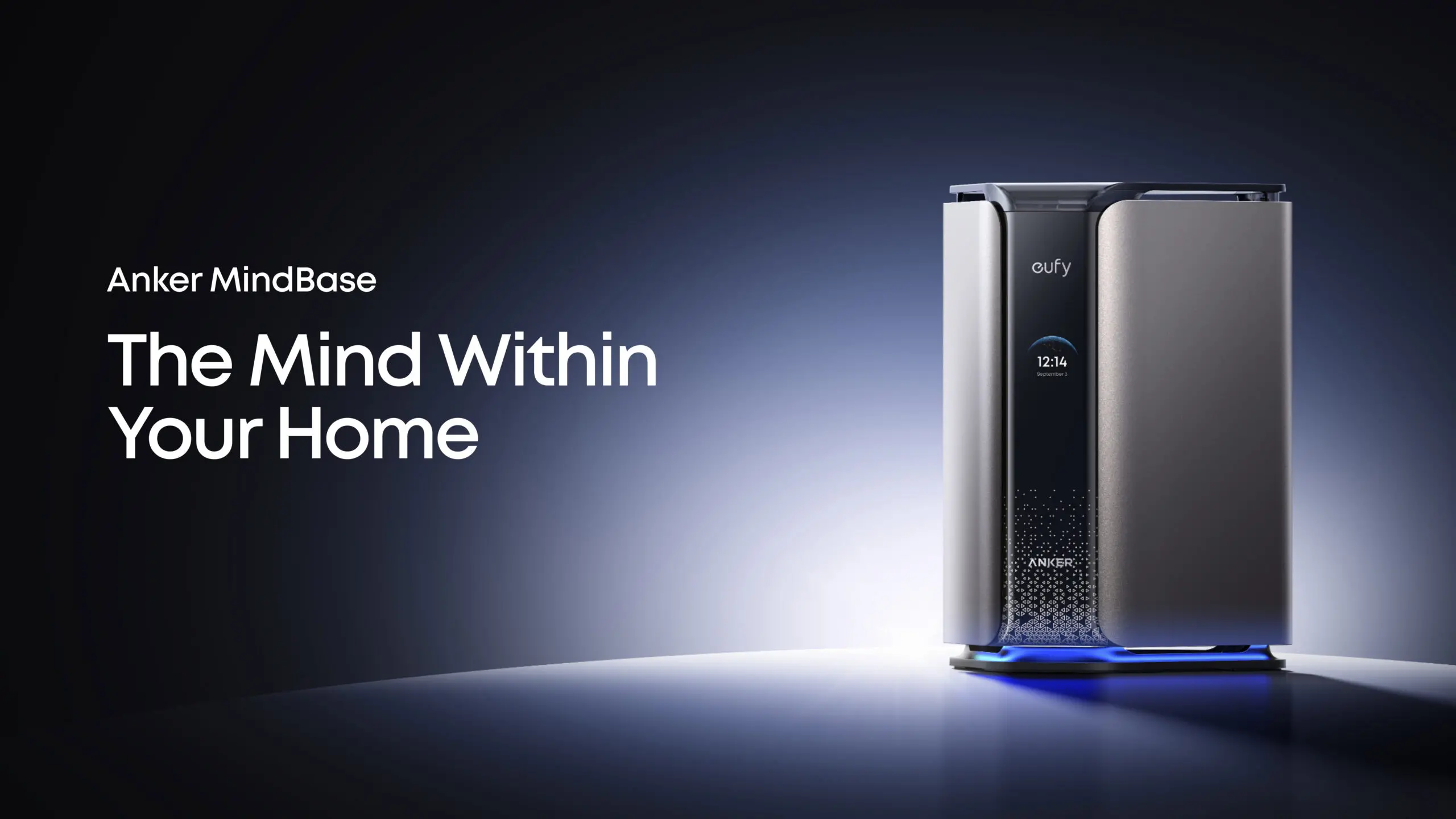
September has arrived, and with it comes one of the biggest technology showcases of the year. IFA in Berlin remains a key event for consumer electronics, offering a glimpse of the products and trends that will define the months ahead. Among the many companies making announcements, Anker is back with a notable lineup that expands beyond its well-known charging accessories. The brand is stepping further into smart home integration and security, presenting a central AI hub along with several new devices under its Eufy sub-brand.
Anker MindBase: A central hub for the connected home
Smart homes have traditionally been a patchwork of apps, protocols, and devices that often struggle to work together. Anker aims to solve that fragmentation with MindBase, an AI-powered hub designed to serve as a central connection point for compatible products. Rather than just acting as another bridge, MindBase promises to bring on-device computing and local storage into the picture, reducing dependence on cloud services while keeping sensitive data closer to home.
MindBase is built around the idea of a whole-home operating layer. In practice, this means it can connect to Anker's security, energy, cleaning, and audio ecosystems. With an integrated Large Language Model, the hub can process AI tasks locally. That could be particularly beneficial for use cases that require low latency or privacy, such as analyzing camera feeds, responding to voice commands, or coordinating automations across different device categories.
One of the headline features is storage. Anker says MindBase can be configured with up to 48TB of local storage, with no monthly subscription fees. For users who rely on security cameras, that addresses a long-standing concern about subscription-based cloud video storage. Instead of sending clips to a remote server, the footage can remain on the hub. The capacity is generous enough to support continuous recording from multiple high-resolution cameras over an extended period, giving households a self-contained and potentially more private alternative.
The vision for MindBase is not exclusive to Anker hardware. Through something called EasyOmni Link, the hub is designed to be compatible with devices that support Matter, Apple HomeKit, Alexa, Google Assistant, and Home Assistant. This cross-ecosystem approach is important. Many households have accumulated devices from different brands and standards over the years. A hub that can communicate with multiple protocols could make it easier to integrate a cohesive setup without forcing a complete replacement of existing equipment.
Anker has not yet announced a starting price for MindBase. The company says more details will be shared closer to the retail launch, leaving potential buyers to wonder exactly how much value the local storage and AI processing will command. Given the range of features, MindBase appears positioned at the premium end of the smart home hub market, appealing to enthusiasts and users with demanding privacy needs.
Eufy NVR Security System E50: Combining two camera types in one
In addition to MindBase, Anker's Eufy brand is adding multiple security devices to its lineup. The Eufy NVR Security System E50 is perhaps the most interesting, as it combines two separate camera technologies into a single unit. The package includes a 2K fixed-lens bullet camera and a 4K PTZ camera. A bullet camera is typically focused on a long-range, fixed view, while a PTZ camera can pan, tilt, and zoom to actively follow a subject or scan an area. By mashing them together, Eufy aims to provide both a stable overview and flexible tracking from one physical unit.
The two lenses are designed to cooperate. When the bullet camera detects a person or object of interest, the PTZ camera can lock on and track it. This dual-camera approach can eliminate a blind spot that traditional fixed cameras face: if someone walks out of a fixed frame, you lose view. With the PTZ camera taking over, the system maintains visual contact.
Eufy also mentions Cross-cam tracking, a feature that lets multiple cameras around a property collaborate. If a subject moves from one camera's zone to another's, the adjacent camera can continue tracking without missing a beat. This kind of multi-camera coordination is becoming more common in premium security systems, but its implementation in a consumer product could make it more accessible.
The E50 system is offered in four- or eight-camera kits. Pricing starts at $999 for the smaller configuration. The top-end eight-camera system with a 4TB hard drive goes up to $1,899. The system is available for pre-order now in the United States, Canada, and Australia. Given the hardware, pricing is competitive with enterprise-leaning brands while still trying to be approachable for residential users.
The bundled NVR (Network Video Recorder) means the system functions as a standalone recording environment, which also lines up with Anker's emphasis on local storage. Security footage can remain onsite rather than being sent to a cloud, a major selling point for privacy-conscious consumers.
Eufy Video Doorbell S4: Finally getting a launch window
Eufy originally teased the Video Doorbell S4 at CES, and the company has now provided a clearer release timeframe. It will arrive in late September for customers in the United States, the United Kingdom, Canada, Northern Europe, Germany, Austria, Switzerland, the Netherlands, Belgium, and Luxembourg. Priced at $299, the package includes a Chime, the in-home module that sounds an alert when the doorbell is pressed.
While the S4 is a refresh of Eufy's doorbell category, it sits at a higher price point than many mainstream models. That suggests Eufy is focusing on enhanced video quality, better motion detection, or deeper smart home integration to justify the premium. At its previous CES teaser, the company highlighted features designed to improve the reliability of identifying people and packages, reducing the number of false alerts that can plague doorbell cameras.
Eufy Window Camera E10: An easy mount security cam
The third new product is a genuinely fresh addition to Eufy's catalog. The Eufy Window Camera E10 is a camera designed to be mounted on a windowpane using a no-trace adhesive sticker, meaning it doesn't require drilling holes. This design is particularly appealing for renters or anyone who doesn't want to leave permanent marks on their property. The camera sits indoors while aiming its lens outward through the glass, capturing what happens outside.
Historically, window-mounted cameras have struggled with glare and reflections, especially at night. Eufy says the E10 has an anti-reflection design along with optimizations to reduce indoor and nighttime reflections. The camera records at 2.5K resolution and supports night vision, AI detection, and 24/7 recording. With a price of $69.99 and a planned Q4 launch, it could be an attractive option for monitoring a front porch, backyard, or other outdoor areas without complicated installation.
The bigger picture in smart home connectivity
The combination of MindBase and Eufy's new security hardware shows how Anker is evolving from a charging accessory maker into a broader consumer electronics ecosystem player. The company has spent years building out sub-brands like Eufy for smart home products, and the latest announcements suggest a more deliberate effort to tie those products together into a coherent system. This is not just about adding devices for the sake of expansion; it indicates an understanding that smart homes need a reliable local brain to handle increasingly complex automations and AI workloads.
Local AI and storage are especially important as privacy concerns continue to grow among consumers. Security cameras collect some of the most intimate data that a household can generate: who comes and goes, what time people are home, and how they move through a property. Sending that footage to a remote server can be unsettling, particularly after a string of high-profile breaches and privacy scandals across the industry. By offering local processing and storage, Anker is positioning itself as a more privacy-preserving alternative to cloud-first competitors.
That approach comes with trade-offs. A hub with up to 48TB of storage is likely to be a significant upfront investment, and users still need to manage that data themselves. Hard drives can fail, and local-only storage means customers must take responsibility for backups or maintaining the hardware. But for those who prioritize privacy, these trade-offs may be worth it.
The inclusion of Matter compatibility is also noteworthy. Matter is an connectivity standard developed by major tech companies to reduce fragmentation in the smart home industry. If MindBase can effectively communicate with HomeKit, Alexa, Google Assistant, and Home Assistant devices, it could bridge the gaps that have historically frustrated users. This approach may be more practical than asking consumers to abandon their existing ecosystem, regardless of how powerful one brand's hub becomes.
The Eufy E50 security system, meanwhile, enters an increasingly competitive market. Traditional camera makers have been adding AI-enabled detection and tracking features, while smart home platforms have also begun bundling security services. Eufy's dual-camera concept stands out by combining fixed and PTZ coverage, but its success will depend on the quality of its software and how well the Cross-cam tracking performs in real-world conditions. If the system can reliably follow a person across multiple camera angles, it could be a genuinely useful feature. If not, the hardware novelty might fade quickly.
Similarly, the Video Doorbell S4 is arriving at a time when video doorbells have become one of the most common smart home purchases. The challenge for Eufy is winning over customers who may already have a doorbell from Amazon, Ring, or Google Nest. The $299 price puts it above many entry-level options, so the brand will need to clearly communicate the added benefits, whether those are enhanced privacy, better image quality, or smarter notifications.
The Window Camera E10 offers an easier installation path, but its reliance on glass introduces variables like thermal tinting and dirty windows that could affect clarity. Eufy's anti-reflection claims are likely to be tested early by reviewers. If the camera works as promised without drilling holes, it could be a hit among renters. If the image remains impaired by glass, it might be a niche product that fails to reach its potential.
Anker's broader strategy reflects a shift in the smart home industry. Rather than simply creating more standalone gadgets, the most important players are trying to build platforms—and ideally, platforms that can connect to devices beyond their own brands. MindBase represents a bold step in that direction, while the Eufy security lineup adds practical hardware that may convince more people to move their data local. The trade show announcements are only the beginning; the real test will come when these products reach consumers and must deliver on the promises of seamless integration and reliable security.
Source: Android Authority News