

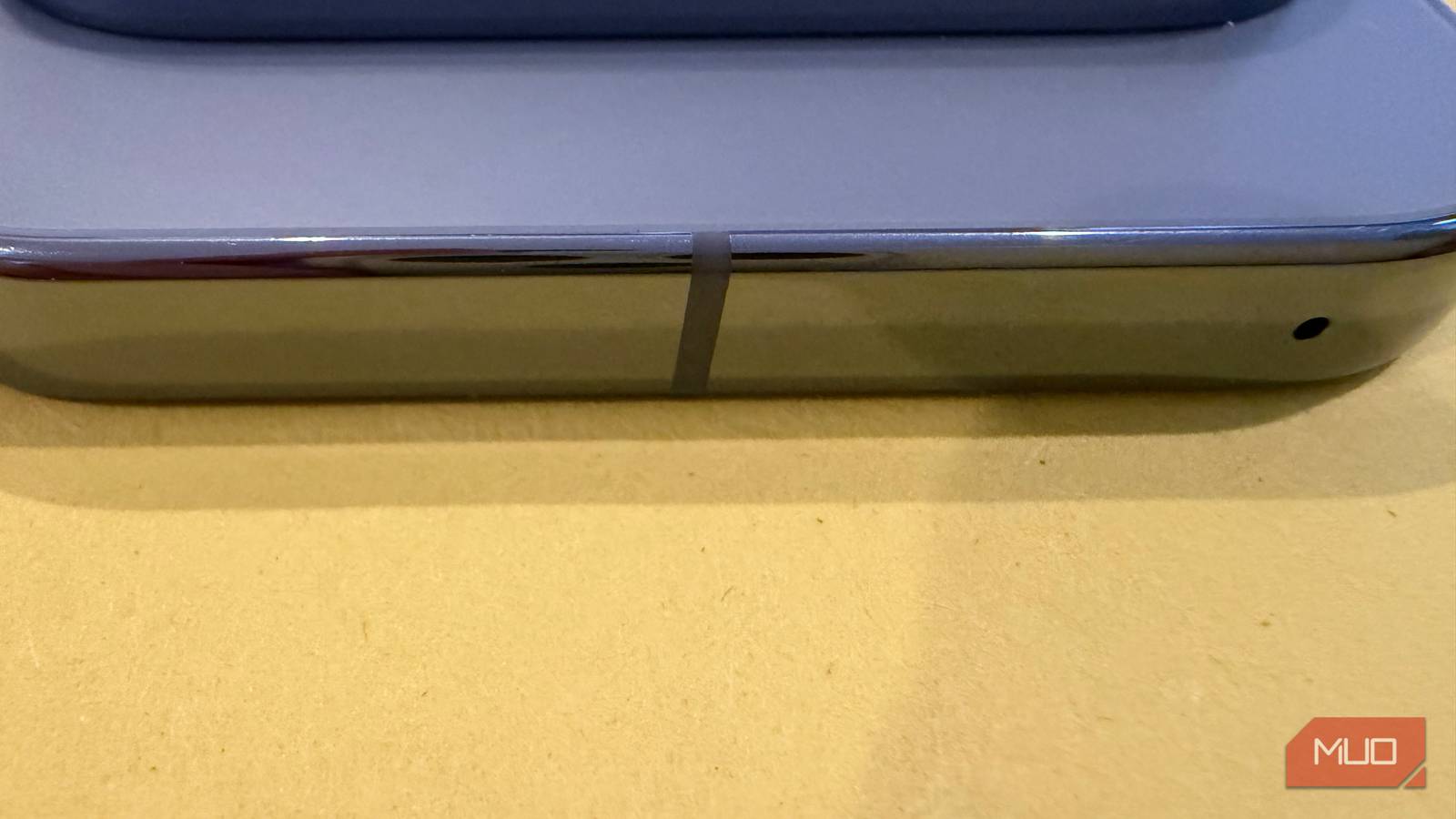
Take a close look at your smartphone. Chances are, its metal frame or back features thin, often subtle lines running along the edges or across the rear panel. You might also notice an oval-shaped cutout that resembles a fingerprint sensor, but it's not. These marks are not decorative—in fact, they are often considered aesthetically unappealing. Yet they exist to solve a fundamental engineering problem that every device manufacturer has faced since the smartphone industry transitioned to metal unibody construction.
What Are Those Lines and Cutouts on Your Phone?
Before diving into the technical details, it's important to identify what these features actually are. On older metal-body smartphones, such as the HTC One M7 from 2013, you'll see prominent plastic strips running across the back. These strips act as separators between different sections of the metal chassis. On more modern devices, like the Samsung Galaxy S22 or iPhone Air, these lines have been moved to the side rails, allowing the back panel to remain a clean, uninterrupted surface. This evolution hides the necessary compromise more elegantly.
They're a Forced Compromise, Not a Design Choice
These plastic or composite lines are often referred to as "antenna bands" or "antenna windows." Their sole purpose is to allow wireless signals—cellular, Wi-Fi, Bluetooth, GPS, and even NFC—to pass through the metal body. Without these gaps, the phone would be a Faraday cage, trapping all electromagnetic radiation inside. That would render the device unable to communicate with cell towers, satellites, or Wi-Fi routers. So while the lines may seem like an afterthought, they are absolutely critical for the phone's functionality.
The Core Problem: Metal Is the Enemy of Wireless Signals
In the early days of smartphones, most phone bodies were made of plastic. Plastic is lightweight, durable, and, crucially, transparent to radio waves. It didn't interfere with the internal antennas, which could be placed anywhere inside the casing. However, as the market matured, manufacturers sought a more premium feel.
The Shift to Metal: Premium Feel, Engineering Nightmare
By the early 2010s, major brands began adopting metal unibody designs. A phone carved from a single block of aluminum—like the HTC One series or early iPhone models—offered several advantages: it looked and felt expensive, with a cool-to-the-touch surface and precise, lustrous edges. Metal also provided excellent heat dissipation, acting as a passive heatsink to draw heat away from the processor and battery. Additionally, metal offered superior structural rigidity, allowing manufacturers to create thinner phones with ultra-thin side rails that wouldn't bend or flex under normal use. A computer numerical control (CNC) machine could mill aerospace-grade aluminum to tolerances measured in microns, enabling designs impossible with plastic.
But metal introduced a major hurdle: it blocks electromagnetic waves. A metal chassis acts as a shielded enclosure, preventing the phone's radio signals from escaping and external signals from reaching the internal antennas. That's the Faraday cage problem. Without a solution, a metal phone would be a sleek but utterly disconnected brick.
The Engineering Solution: Plastic and Glass Windows
To work around this, engineers created intentional gaps in the metal chassis and filled them with non-conductive materials such as plastic or composite polymers. These antenna bands serve as windows through which radio waves can pass. The placement of these bands is critical—they are positioned where the internal antennas are located, typically at the top, bottom, and sometimes the sides of the device. By inserting these plastic strips, the metal body is divided into several isolated segments, each of which can be used as an antenna element itself. This technique, known as "slot antenna" or "IFA (Inverted-F Antenna) design," allows the metal frame to double as the radiating structure while the plastic breaks prevent short-circuiting.
Another approach, especially popularized by Apple and Google, is to use glass cutouts on the back panel. For example, the "visors" on Pixel devices or the glass back on most iPhones (since the iPhone 8) allow both wireless signals and Qi wireless charging to pass through. Full glass backs, often paired with a metal frame, have become the standard in modern smartphones. The glass is transparent to radio waves, eliminating the need for plastic strips on the back. However, the metal frame still requires antenna bands—these are now tucked along the side rails, where they are less noticeable. Even Samsung's Galaxy phones, which use a glass back that mimics the look of metal, still have distinct plastic lines on the metal frame.
The Large Oval Cutout: Your mmWave 5G Antenna
On some recent smartphones, particularly those sold in the United States from 2020 onward, you may notice a larger oval cutout along the edge of the phone. It often looks like an elongated fingerprint sensor but is actually an antenna window for millimeter-wave (mmWave) 5G.
What Is mmWave 5G and Why Does It Need a Special Window?
mmWave is a flavor of 5G that operates at extremely high frequencies—typically between 24 GHz and 40 GHz. These signals can carry massive amounts of data at very low latency, theoretically enabling gigabit-per-second speeds. However, mmWave has severe limitations: it can only travel short distances (a few hundred feet), is easily blocked by buildings, trees, and even human bodies, and it consumes a considerable amount of battery power. As a result, mmWave networks have been deployed only in dense urban areas—such as stadiums, airports, and city centers—and even then, coverage is spotty.
Because mmWave signals are so high-frequency and easily attenuated, they require a larger antenna window than the bands used for sub-6 GHz signals (4G/LTE, low-band 5G, Wi-Fi). The oval cutout you see on phones like certain iPhone 12/13/14 models (US variants) and Samsung Galaxy S22/S23 series (US carrier models) provides a clear path for these millimeter waves to reach the internal phased-array antenna module. The antenna itself is often placed just behind this window, mounted on a small printed circuit board. In many devices, this mmWave antenna is only present on models sold in the US because carriers like Verizon and AT&T invested heavily in mmWave infrastructure. Globally, most phones lack this oval cutout because mmWave is rare or nonexistent.
Despite the hype, the vast majority of smartphone users have never connected to an mmWave network. The antenna bands for low- and mid-band 5G, along with 4G and Wi-Fi, are far more critical for everyday connectivity. So those small plastic lines are actually the workhorses of your phone's wireless capabilities.
Why Those Lines Are Still Here: The Ongoing Evolution
As phone designs continue to mature, manufacturers have learned to hide these antenna bands more effectively. Many devices now use glass backs exclusively, moving the metal only to the frame. But even on premium phones with titanium or stainless steel frames, the need for antenna windows persists. The lines have become thinner, less obtrusive, and are often painted over to match the surrounding metal. Some phones, like the Google Pixel 8 Pro, place the antenna bands on the bottom edge, nearly invisible when looking at the phone from the front or back.
Another trend is the move away from metal entirely in some devices. The iPhone XR and iPhone 14/15 standard models use aluminum frames but still have antenna bands. Higher-end models like the iPhone 15 Pro use titanium, which is also problematic for wireless signals—though slightly less so than aluminum. Even with titanium, plastic inserts are necessary.
The industry may eventually shift to materials that are both structurally robust and radio-transparent, such as certain high-strength ceramics or glass composites. For now, though, those little plastic lines—and sometimes a larger oval—are an inescapable part of every smartphone's anatomy. They are a compromise between aesthetics and engineering, a silent testament to the challenge of fitting powerful radios into a small, beautiful, and durable metal box.
Every time you make a call, stream a video, or use GPS, those lines are hard at work, allowing the invisible waves that connect you to the world to pass through the metallic shell. They may be ugly, but they are indispensable.
Source: MakeUseOf News