

While Silicon Valley rattles through all the teraflops money can buy in its pursuit of artificial general intelligence, we’re going to need a stopgap phenomenon to pass the time. That phenomenon, agentic artificial intelligence (AI), has emerged as a bridging term between traditional AI and whatever might come next. It is identified by its ability to self-learn and function without human involvement, as well as its apparent readiness to take on some of our most repetitive administrative responsibilities.
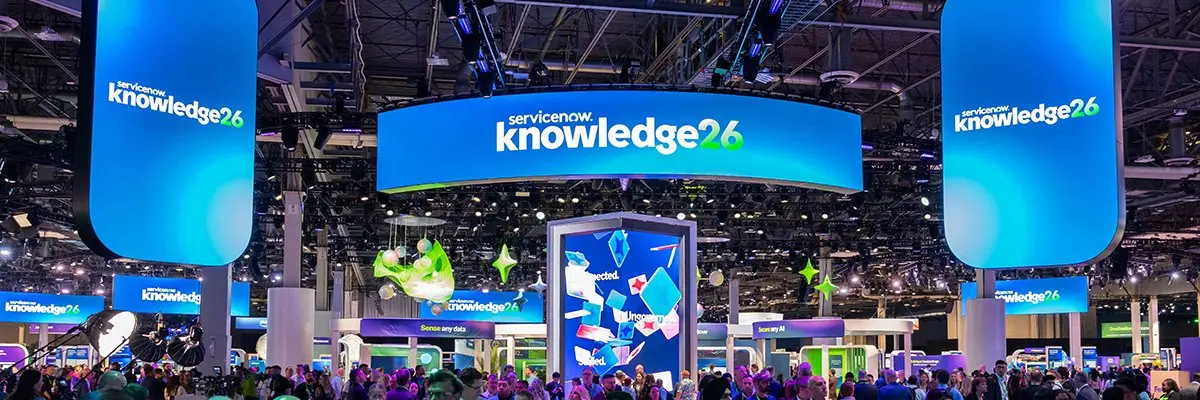
Reportedly coined by computer scientist Andrew Ng in 2024, agentic AI represents a leap forward from earlier AI models. Unlike chatbots or predictive algorithms that require constant human oversight, agentic AI systems can perceive their environment, set goals, and execute multi-step tasks with minimal intervention. This capability has captured the imagination of enterprise leaders, who see it as a way to automate complex workflows and boost productivity. At the ServiceNow Knowledge 2026 event in Las Vegas, the term took center stage, with executives proclaiming that agentic AI has gone from concept to a full-blown movement.
The Movement Takes Center Stage
For the second year running, ServiceNow CEO Bill McDermott used its Knowledge event to hail the progress of AI agents on its platform. Company president Amit Zavery carried that torch into the conference’s second day. “What happened in technology over the last year has exceeded everyone’s expectations,” said Zavery in his day two keynote. “Agentic AI has gone from concept to a movement. The pace of innovation has never been faster, and the security landscape has fundamentally changed now AI agents are working with us every day.”
Zavery’s comments reflect broader industry trends. According to market research, the global agentic AI market is projected to grow at a compound annual rate of over 40% through 2030, fueled by demand for autonomous systems in customer service, IT operations, and supply chain management. ServiceNow, which began as an IT service management platform, has expanded into a comprehensive workflow automation vendor, and its AI agents are now central to that vision.
Observing Customers: The North Star
ServiceNow’s latest advancements are a particular source of pride for its group vice-president of customer relationship management (CRM) and industry workflows, Terence Chesire. He helped launch the CRM workflow product 10 years ago and told Computer Weekly this year’s announcements were “most certainly” the firm’s biggest yet. “We started off with a fairly different view in the CRM market around workflow … helping organisations describe what they sell, how they sell them, as well as when they’ve sold them; what their customers are able to request; and what types of service and support they should get, such as warranties,” said Chesire. “These announcements are another step function in bringing AI in a thoughtful way, where we think it’s not ‘or’ – it’s ‘and’.”
“The power of AI is in making it super easy for people to interact with computers,” he continued. “We’re all experiencing it. But in the business context … it’s being able to accomplish something. For us and CRM, [the question is] does it help the customer get the product they want, and when they need support, do they get the right support?”
Chesire emphasized that the best way to differentiate valuable AI breakthroughs from fads is to pay attention to customers’ needs. “The North Star for us, and for myself, was, from the beginning … observing what customers were doing,” he said. “So, 11 years ago, when we were looking at the genesis for this [workflow], we saw customers customising on the platform … and we were very curious. They told us the systems they had at the time did a part of the process. They helped do interactions, but [our customers] still needed to stitch together [processes] to accomplish what they wanted.”
This helped inform one of the major selling points ServiceNow markets so effectively: an end-to-end experience where various apps seamlessly coexist to complete their complementary tasks. “Even with AI, we still look for tangible business value,” added Chesire, providing an example of the issues he seeks to solve: “Customers say things like, ‘My team members are simply reading emails and scrawling through log files, and not actually spending time with their customers.’” He recounted a meeting with a Japanese customer who said they were “now getting much richer insights from the call summarisations and the Assist context than we ever did [before],” because the machine is able to get a perfect summary of what the customer asked for. “And the team members are much happier, because they get 60% more time to talk to customers, and not do all the work they were told they had to do before,” he added.
A Quick Headcount: Workforce Implications
But just as Big Tech encourages us to embrace our AI colleagues, stories abound of those same companies swiftly restructuring their workforces to maximise their investments. Some employee side-effects of the agentic revolution are still coming into full view. McDermott told the press at day one’s fireside chat there was no alternative to the pace of change, and noted ServiceNow’s AI training initiative as an option for those still unconvinced.
“Anxiety is understandable,” he said. “A lot of people actually really don’t understand all the nuances of AI: ‘It’s either good or it’s bad. It’s good because you can cut headcount: it’s bad because you can cut headcount.’ But it’s so much more nuanced than that,” said McDermott. “We’re committed to our RiseUp programme, training three million people, at no cost, to get them initiated in the AI economy.”
McDermott also highlighted demographic and economic pressures that make AI adoption imperative. “If you think about the issue … if you take Germany, the UK, Japan and the US, by 2030, you’ll have a 50 million-person shortage in the tech community. You have fertility rates in the global economy dropping, and you have a headcount of workers in the enterprise absolutely flatlining. What is going to improve productivity when, at best, you have the same amount of people doing the work?” he asked, before channelling the great American industrialist Henry Ford: “If you always do what you always did, you always get what you always got.”
The RiseUp program, launched in 2020, aims to equip individuals with skills in digital workflows, AI, and automation. Participants gain access to free training courses, certifications, and job placement support. ServiceNow has reported that over 1.5 million people have already enrolled, with a focus on underrepresented groups and communities facing economic challenges. This initiative is part of a broader trend among tech companies to invest in reskilling as AI transforms job roles.
Nvidia Partnership: Powering the AI Factory
Computer Weekly asked Chesire for his pick of the partnerships announced at Knowledge 2026, providing the perfect opportunity to summon the world’s first $5tn company: Nvidia. “Nvidia is obviously a very exciting company, and a great partner,” he said. “In the sales realm, these are really powerful chips that they sell. What most people don’t realise is the chips go inside racks that go into chassis that have very specific requirements on communication cabling that goes in the back – power cabling, cooling requirements. These are massive systems.”
“And so, the power of AI, and the deterministic core, to build those things out, is why they went from over five days to build one of these systems, to minutes,” said Chesire. “That is how [ServiceNow] makes a seller or even a customer who’s waiting for one of these systems get exactly what they need, better.”
The partnership between ServiceNow and Nvidia has deepened over recent years. Nvidia uses ServiceNow’s IT service management platform to manage its own infrastructure, while ServiceNow leverages Nvidia GPUs to accelerate AI model training and inference. At Knowledge 2026, the two companies announced new integrations that allow Nvidia’s AI agents to automatically detect and resolve hardware issues in data centers, reducing downtime and maintenance costs.
Chesire’s insight into ServiceNow’s Nvidia contract speaks to a life’s passion for optimising workflows at the top table of the global economy, where minimising errors in the production line stands to save the customer unspeakable expense. “A key part of what makes Nvidia different is its software that works with their chips,” he said. “Most people don’t realise that. Just like any other software, sometimes there are defects. But they’re hard to find. And so what we do on the AI agent side is understand and analyse the telemetry – what was going on; what was the workload; what was the unique condition? – to summarise and put it to a really sophisticated AI engineer, who really doesn’t want to spend their time going through log files, to say, ‘This was the specific thing that was going on at that time.’”
“But then … there’s always the work we tell people they should do,” added Chesire. “One of the things we tell people is, ‘You should write a knowledge article about what you did to fix it.’ No one ever did it. So the AI agent also writes the knowledge article to say, ‘Here’s the specific model, the deep specificity on what was going on, and what fixed it,’ and it helps the next team member and the next AI agent do better.”
This capability—autonomous knowledge creation—is a hallmark of agentic AI. By not only solving problems but also documenting the solution in a human-readable format, these agents create a virtuous cycle of continuous improvement. It also addresses a longstanding pain point in IT operations, where tribal knowledge often resides solely in the heads of senior engineers.
Agentic AI in CRM: Beyond Hype
ServiceNow’s CRM workflow product, built on its Now Platform, now incorporates a suite of agentic AI tools. These include an AI sales agent that can qualify leads, schedule meetings, and generate personalized proposals; a service agent that handles customer inquiries autonomously; and a marketing agent that can optimize campaigns in real time. According to Chesire, the goal is to free up human employees to focus on high-value interactions that require empathy, creativity, or strategic thinking.
“The CRM market has been dominated by traditional players that focus on data entry and pipeline management,” Chesire explained. “We are redefining it by turning CRM into an intelligent system that works on behalf of the customer. For example, when a customer submits a request for quote, our AI agent can automatically gather pricing from multiple sources, check inventory, and generate a response—all without human intervention. If a discrepancy arises, it escalates to a human with a full context summary.”
He also emphasized that ServiceNow’s approach is to integrate AI into existing workflows rather than creating siloed AI products. “We believe AI should be a layer that runs across all applications. That’s why our agentic AI is built into the platform, not bolted on. It understands the entire lifecycle of a customer interaction, from the first marketing touch to post-sale support.”
This integrated approach has resonated with enterprises looking to modernize their customer experience without overhauling their entire tech stack. ServiceNow claims that early adopters of its agentic CRM have seen a 30% reduction in response times and a 20% increase in customer satisfaction scores.
The Broader Context: Agentic AI as a Movement
The term “agentic AI” has gained traction as the industry seeks to distinguish between generative AI, which produces content, and AI that can take action in the world. Andrew Ng’s coinage in 2024 captured a shift from passive models to active agents that can plan, execute, and adapt. At ServiceNow Knowledge 2026, this concept was front and center, with product demos showing AI agents handling everything from password resets to complex supply chain optimizations.
Other technology firms are also investing heavily in agentic AI. Microsoft has introduced Copilot agents that can automate workflows across Office 365; Salesforce launched Agentforce for sales and service; and startups like Cognition AI are building autonomous coding agents. However, ServiceNow positions itself as uniquely equipped to orchestrate these agents across enterprise departments, thanks to its workflow-first architecture.
“Agentic AI is not just a feature—it’s a new way of thinking about how work gets done,” said Zavery. “We are moving from a world where humans do the work and computers assist, to a world where AI agents do the work and humans guide them. That shift will redefine productivity in every industry.”
As the conference wrapped up, attendees left with a sense that the agentic AI movement is only accelerating. With Nvidia’s computing power, ServiceNow’s workflow expertise, and a growing ecosystem of partners, the vision of autonomous enterprise operations is closer than ever. The question now is not whether agentic AI will become mainstream, but how quickly organizations will adapt to a world where machines don’t just think—they act.
Source: ComputerWeekly.com News