

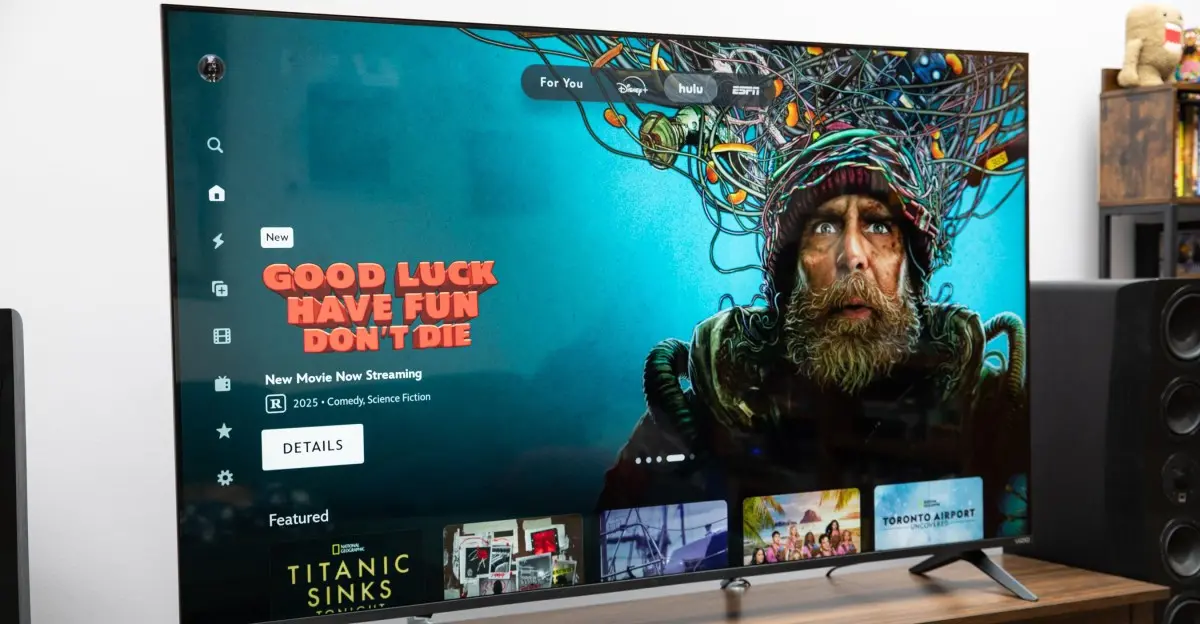
When Vizio released its Mini LED Quantum TV series, the headline seemed straightforward: a quantum-dot mini-LED TV for under $400. That alone is a feat—quantum dots deliver higher brightness and more accurate color than standard LED TVs, and mini-LED backlighting improves contrast. But after spending time with the 65-inch model, a different story emerged. Vizio, now owned by Walmart, accidentally created the best dumb TV on the market, and that might be exactly what many buyers need.
The TV is available now at Walmart in sizes from 43 inches to 85 inches. The 65-inch model we tested costs $398, the 75-inch is $498, and the 85-inch is $768. For each size, you get a Mini LED panel with quantum dots, support for Dolby Vision and HDR10+, and Vizio's own operating system. But the OS is where things get complicated—and where the opportunity for a dumb TV arises.
The Walmart connection and data tracking
Walmart acquired Vizio in 2024 primarily for its advertising business. Every Vizio TV now integrates with Walmart's ecosystem. During initial setup, you are prompted to sign in to or create a Walmart account. If you do, you agree to share your viewing data, which Walmart can use to target shopping recommendations. Even without an account, the TV asks you to accept an Activity Data Policy before you can use streaming apps like Netflix or YouTube. Refusing that policy locks you out of the smart TV features entirely.
This data collection is not uncommon—most smart TVs track what you watch. But the direct link to a retailer’s account makes it more unsettling. According to Vizio’s privacy policy, even if you use an external streaming device connected via HDMI, the TV can still scan the HDMI port and collect data on what is being displayed. The only way to fully escape this tracking is to make the TV a dumb TV.
How to turn the Vizio into a dumb TV
Remarkably, Vizio allows you to completely avoid the smart TV features during setup. After turning on the TV, you are given the option to connect to Wi-Fi. If you skip this step, the TV immediately switches to an HDMI input. You are then asked to sign into a Walmart account or create one. Choosing “skip” brings up a warning that you will not be able to manage payments or link devices. Skipping again leads to the Activity Data Policy. Declining that brings another warning: “skipping this step means missing out on all your Vizio smart TV features, including apps like Netflix, YouTube, and other apps.”
If you persist and decline again, the setup ends. The TV becomes a bare display with no internet connection and no smart functionality. You can also later forget the Wi-Fi network to ensure no data is sent. This is a rare option; most modern televisions force you to accept some level of data collection just to finish setup. The ability to use the TV as a pure monitor—with three HDMI ports and an ATSC 1.0 tuner—makes it ideal for anyone who wants to control their own streaming experience with a separate device like an Apple TV or Fire Stick.
Picture quality for the price
The Vizio Mini LED Quantum delivers surprisingly good image quality given its price. In its Calibrated picture mode, the TV measured a peak brightness of 936 nits for small HDR highlights—exceptional for a budget set. SDR content reaches about 309 nits, which is more than adequate for a bright room. Colors are accurate, with a slight blue cast that most viewers will not notice. The Calibrated Dark mode reduces brightness but improves black levels in a dark room.
However, the TV uses an IPS panel rather than VA, meaning its native contrast is lower. Black levels are not as deep as more expensive TVs, and blooming is visible around bright objects on dark backgrounds. The screen is glossy, so reflections from lamps or windows can be distracting during dark scenes. Motion handling is decent but not perfect; fast-moving content like Formula 1 races shows some blur. For everyday use—watching news, sports, or streaming shows—the picture is very enjoyable. You are unlikely to feel shortchanged, especially considering the price.
Build quality and connectivity
Cost-cutting is evident in the build. The entire back panel is cheap plastic. The two feet have only one height position, and the cable management channel on each foot can only hold a single cable. If you have multiple devices, you cannot run all cables through the channel. The TV has three HDMI 2.0 ports, which is fewer than the typical four, and none support HDMI 2.1 features like 4K/120Hz for gaming. There is one USB 2.0 port, an optical audio output, and an antenna connection. The speakers are loud but lack bass and clarity, which is common for budget TVs.
For gaming, the TV supports 4K/60Hz on all inputs and 1080p/120Hz on the 65-inch and larger models. This is adequate for most console gamers, but serious players may want a TV with HDMI 2.1 for variable refresh rate and low latency at 4K.
The best dumb TV for now
The Vizio Mini LED Quantum TV fills a niche that has nearly disappeared. Most TVs at this price force you into a smart platform with data tracking. Vizio’s ability to skip all that and act as a pure display is a rare gift. The picture quality is excellent for the money, and the presence of quantum dots gives it an edge over many similarly priced competitors. The main concern is whether future software updates will remove the option to skip the smart features. Vizio has not indicated any changes, but Walmart’s acquisition makes the TV’s long-term direction uncertain.
Until then, if you want a large, affordable TV without being forced into a data-sharing ecosystem, the Vizio Mini LED Quantum is the best option available. Just ignore the smart features, plug in your own streaming device, and enjoy the display. It may have been an accident, but it is a happy one.
Source: The Verge News