

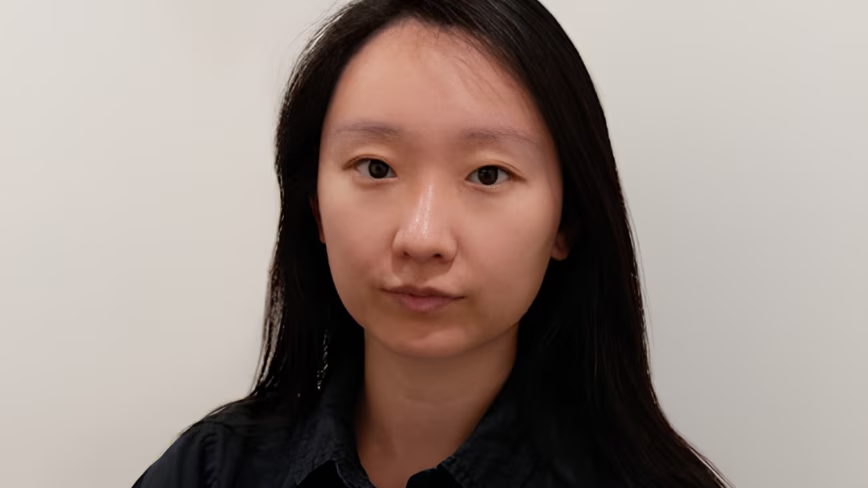
Artificial intelligence has dramatically accelerated software development, making it easier than ever to transform ideas into working products. According to Stanford’s recent report, AI performance on a key coding benchmark jumped from 60% to nearly 100% in a single year, while organizational AI adoption reached 88%. As AI capabilities continue to expand, Tingyu Su believes the challenge is no longer simply building software. It is creating products that people immediately understand, trust, and choose to adopt.
Su, a startup founding designer with experience spanning creative technology, product innovation, and multidisciplinary design, argues that this shift has made the founding designer an increasingly important early hire. While startups often prioritize engineering talent, they also need someone who can connect product development, branding, and customer experience into a cohesive whole from the very beginning.
The changing landscape of AI product differentiation
“The speed of AI development has changed what companies compete on,” Su says. “Building an early product is becoming more accessible. Creating a brand and experience that people immediately understand, trust, and remember is where lasting differentiation begins.”
Customers often form opinions about a company well before they ever use its technology, Su notes. “A website, conference booth, presentation deck, or marketing material may become the first interaction someone has with an organization,” she says. She recalls a recent industry conference where a prospective customer stopped by the company’s booth and remarked that the materials felt clean and immediately understandable, and looked noticeably more refined than those of the surrounding exhibitors. For Su, moments like that confirm why every touchpoint should reinforce the same identity customers eventually experience inside the product itself. A startup’s product will change many times, she says, but a thoughtfully built brand is the one thing that shouldn’t. For AI startups, that consistency is what earns customers’ trust before the technology proves itself.
The multidisciplinary background of Tingyu Su
Su’s multidisciplinary career has influenced how she approaches design. Her experience spans art institutions, creative agencies, consumer brands, and technology companies, backed by formal training in communication design and product innovation. Her work has also been recognized with an iF Design Award, and she contributed published research presented at the CHI 2025 conference. Today, she applies that broad perspective as the founding designer at Youlify, a Silicon Valley healthcare AI startup developing revenue cycle management technology for healthcare organizations and providers.
Before entering the startup ecosystem, she worked across prominent cultural institutions, including the Museum of Modern Art, Solomon R. Guggenheim Museum, and Rubin Museum of Himalayan Art. These experiences strengthened her understanding of storytelling, accessibility, and large-scale design systems. She later expanded that perspective through creative agencies, consumer brands, and product innovation before moving into AI startup leadership, where she now combines design, technology, and business strategy to help shape emerging products.
The Minimum Lovable Product approach
Su also believes expectations for early-stage products have evolved alongside AI. While the minimum viable product remains a valuable way to validate ideas, she says functional software alone is rarely enough to earn customer confidence. Instead, she encourages founders to think about creating a Minimum Lovable Product: an experience that is clear, intuitive, and trustworthy from the very first interaction. According to Su, thoughtful design helps turn an early prototype into a product that people are willing to adopt and recommend.
“A product does not need dozens of features to make an impression,” Su says. “Sometimes one carefully designed experience that clearly solves a real problem creates far more confidence than a long list of capabilities people never fully understand.”
This philosophy is particularly relevant in the healthcare AI space, where trust and clarity are critical. Youlify’s revenue cycle management technology helps healthcare organizations streamline billing and administrative processes. By prioritizing design from day one, the company aims to create a product that not only functions well but also feels reliable and easy to use for busy healthcare providers.
AI is reshaping the role of designers
According to Su, AI is reshaping the role of designers as much as it is reshaping technology. She believes the next generation will contribute across branding, product strategy, customer research, and engineering instead of remaining confined to traditional design responsibilities. She says AI tools and a growing technical understanding are enabling designers to collaborate more closely with engineering teams throughout product development.
Su encourages founders making their first design hire to prioritize curiosity, initiative, and systems thinking alongside technical ability. She explains that early-stage startups rarely have the structure for highly specialized roles, making adaptability an important characteristic for anyone joining the founding team. Designers who proactively explore customer problems, collaborate across departments, and confidently recommend practical solutions often contribute well beyond traditional design responsibilities.
“The most valuable founding designers are constantly learning alongside the company,” Su says. “They are willing to understand the customer, work closely with engineers, contribute to business conversations, and refine every experience as the company evolves.”
Why design consistency builds trust in AI startups
Trust is a fragile commodity in the AI industry. With rapid technological changes, privacy concerns, and market hype, customers are skeptical. Su argues that a consistent brand experience, from the first marketing touchpoint to daily product use, is the most effective way to earn and maintain trust. She points out that in her experience at healthcare AI startup Youlify, the design team works alongside product managers and engineers to ensure that every interaction feels intentional and aligned with the company’s values.
“The companies people remember are the ones that make every interaction feel intentional,” Su says. “Technology will continue to evolve, but trust is built through experiences that feel consistent from the first impression to the product itself. That is where I believe the founding designer creates lasting value.”
Expanding on the strategic value of the founding designer
While engineering remains fundamental, the founding designer brings a unique ability to synthesize customer needs, business goals, and visual communication into a coherent strategy. In AI startups, where the product is often invisible or abstract (like algorithms processing data), design makes the technology tangible and accessible. A well-designed interface, clear onboarding, and intuitive workflows reduce friction and accelerate adoption. Moreover, as AI models become commodities, user experience becomes the key differentiator.
Su’s own journey illustrates this trajectory. At the Museum of Modern Art, she learned how to design for diverse audiences and large-scale installations. At the Guggenheim, she honed her skills in spatial design and narrative. Later, in consumer brands and creative agencies, she mastered the art of emotional connection through branding. This cross-sector experience now allows her to anticipate how healthcare professionals will interact with AI tools, and to design systems that respect their workflows while introducing new efficiencies.
The healthcare industry is notoriously complex, with strict regulations and legacy systems. Youlify’s technology must seamlessly integrate with existing electronic health records and billing platforms. Su’s design leadership ensures that the user experience remains consistent regardless of the underlying complexity. This is where the founding designer’s systems thinking becomes critical: not just designing screens, but designing the entire end-to-end experience, including error states, data visualization, and support for multiple user roles.
Su also emphasizes that founding designers must be comfortable with ambiguity. In early-stage startups, product requirements change rapidly. A designer who can iterate quickly, test assumptions with customers, and adapt to new information is invaluable. She recommends that founders look for designers who have a growth mindset and a portfolio that demonstrates adaptability across different mediums.
Looking ahead, Su predicts that the role of design in AI startups will continue to evolve. As AI becomes more embedded in everyday products, designers will need to address ethical considerations, such as bias in algorithms and transparency in decision-making. The founding designer must champion these principles from the start, embedding them into the company culture and product design.
In the competitive landscape of AI, where many startups fail due to lack of traction rather than technological shortcomings, the founding designer can be the difference between a promising demo and a product that users truly love. By treating the design hire as a strategic partner from the beginning, founders can build products that not only work but also resonate deeply with their target audience.