

Your ISP’s DNS is probably the weakest link in your connection right now, and there’s zero reason to stick with it. But even if you know that, the bigger question is what DNS you should switch to because every option seems to market itself as the fastest and most private.
The honest answer is that no one can tell you which DNS is best for your connection. The only way to actually know is to test them yourself. That’s exactly what I did, and the best DNS server wasn’t the one I had been using for months.
The best DNS isn’t the same for everyone
The fastest DNS for me might be the slowest for you
By default, your devices stick to your ISP’s DNS server for translating website names into IP addresses. But the thing is, ISP-provided DNS servers are rarely good. And this isn’t something you’ll usually notice. The bigger issue is that those DNS queries are essentially what you browse. That means your ISP can easily log your internet activities and monetize that data.
That’s why switching to a third-party DNS server is almost always better. There are plenty of good ones out there, like Google DNS, Cloudflare, Quad9, NextDNS, AdGuard, and ControlD. The catch is that there isn’t a single “best” DNS server for everyone. DNS performance depends on a lot of things, like physical proximity to servers, how well a provider’s network is peered with your ISP, and even time of day.
Cloudflare might be the fastest option for someone, while Google DNS or Quad9 might perform better for someone else. The reason is simple. A DNS with 50+ global nodes will behave differently depending on which node your traffic actually hits. So yes, the “best” DNS for me won’t apply to you, and vice versa. The only reliable way to pick a DNS is to test it on your own device and network.
Understanding how DNS works helps appreciate why testing matters. The Domain Name System is like the phonebook of the internet. When you type a website name, your device asks a DNS server to look up the corresponding IP address. This lookup happens in milliseconds, but if the DNS server is far away or overloaded, it adds noticeable latency to every page load and video stream. Your ISP’s DNS servers are often located in your region, but they are not optimized for performance. Many ISPs use outdated hardware or prioritise cost savings over speed. Third-party providers invest heavily in distributed server networks, anycast routing, and caching layers to deliver faster responses.
Beyond speed, privacy is a major motivation for leaving ISP DNS. When you use your ISP’s DNS, every website you visit is recorded. Some ISPs sell this browsing data to advertisers. Third-party providers like Cloudflare and Quad9 have strict no-logs policies and encrypt queries with DNS-over-HTTPS or DNS-over-TLS. Some even block malicious domains automatically. However, the privacy policy of a DNS provider is only effective if the provider is trustworthy. Reading their privacy policies and understanding their business model is essential.
The performance of a DNS server can also change throughout the day. During peak internet usage hours, your ISP’s backbone might become congested, slowing down all traffic including DNS queries. A third-party server that was fastest in the morning might lag in the evening because of global load balancing or routing changes. This is why running the test multiple times at different hours gives a more accurate picture. You can even set up a schedule to ping the servers and log response times over a week to see the trends.
DNS Speed Test found the best server for me in under 30 seconds
No need to install anything
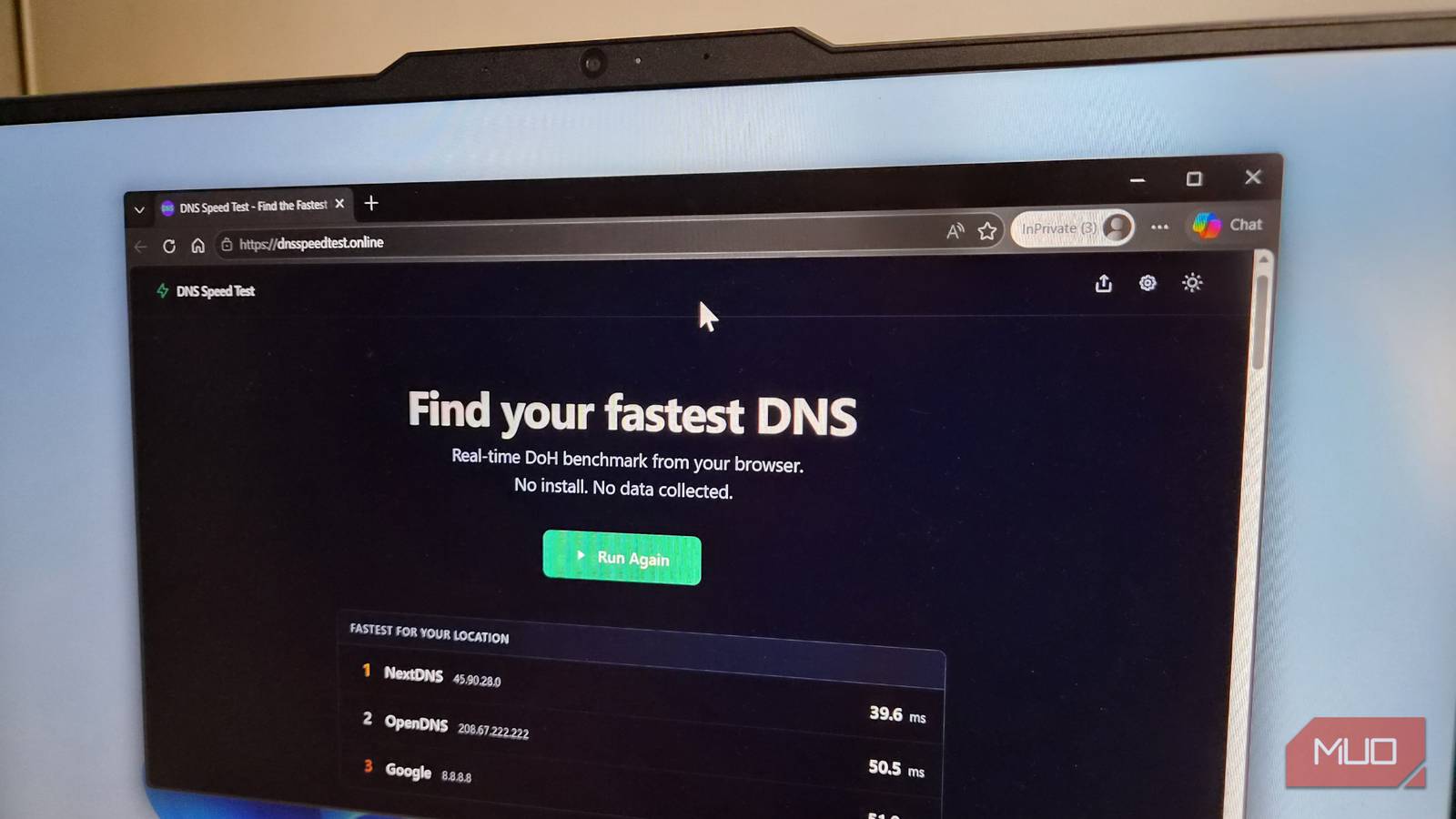
There’s no shortage of DNS benchmarking tools, but most of them either require an installation or spit out raw numbers that can confuse you even more. And that’s exactly why I like the DNS Speed Test tool. It’s a free browser-based tool that tests popular DNS servers from your current network.
It fires several DNS queries to each server and measures how long they take to respond. It even runs a warm-up phase before timing each server, so the results reflect actual everyday performance. The whole thing takes around 30 seconds or less, and when it’s done, it shows you the top three DNS providers for your setup.
You can then scroll down and see how other DNS servers have performed. You’ll see the minimum, maximum, median, and average speeds of each DNS provider so you can pick the one that’s not just fast but consistent. The most important thing here is that you shouldn’t just run the test once and commit. As I said earlier, DNS performance can vary depending on the time of the day. So run this test at different times of the day to factor in network congestion.
You can even customize this test. By default, DNS Speed Test queries popular sites like Google, YouTube, ChatGPT, and Reddit. These are sites that most DNS providers actively cache to make their numbers look better. If you want the most accurate picture, edit that list to include domains you actually visit on a daily basis. For instance, if you frequently use social media platforms like Facebook, Instagram, and Twitter, or streaming services like Netflix, Hulu, and Spotify, adding those domains will give you a benchmark that reflects your actual browsing experience. The tool allows you to paste a list of up to 10 domains, separated by commas. After editing, the test will query only those domains against each DNS server. This is a powerful way to cut through the marketing hype and see how each provider performs under real-world conditions.
The tool also provides a “Details” tab where you can see a per-server breakdown of response times for each domain. If one server resolves YouTube in 5 milliseconds but another takes 100 milliseconds, you can immediately see which one is better for that specific site. Over time, if you notice that one DNS is consistently faster for your most-used services, that becomes your top candidate. Another feature is the “Export” button that downloads a CSV file with all raw data. You can then import it into a spreadsheet and perform your own analysis, like calculating percentiles or comparing day-to-day variability. This is especially useful if you are a network enthusiast or an IT administrator managing multiple devices.
DNS Speed Test is built on JavaScript and uses the browser’s built-in DNS resolution API (though some browsers limit this). It sends requests to each server in parallel, then waits for responses. A warm-up phase ensures that cached results don’t skew the numbers. The tool is open source, so you can inspect the code on GitHub to verify no data is collected. The test respects your privacy because everything runs locally in your browser. No results are sent to third parties. If you prefer an even more minimalistic approach, you can also use the command-line tool “dnsping” or “dnstt.py” but those require Python installation. The browser method remains the easiest for non-technical users.
Speed isn’t the only thing to look for when picking a DNS
Speed is important when picking a DNS server, but it shouldn’t be the only one you look at. That’s because most third-party DNS servers do more than simply resolve requests. For instance, Quad9 is known for its security features. It checks every request against multiple threat intelligence feeds. If you accidentally click a phishing link, there’s a good chance Quad9 will block it before the page loads. It also supports DNS-over-HTTPS and DNS-over-TLS for encrypted queries. Quad9 is operated as a non-profit, so it doesn’t monetize your data. However, because it does block malicious domains, there is a marginal increase in resolution time for those queries. But for legitimate sites, the speed is comparable to other major providers.
Cloudflare’s 1.1.1.1 is another top choice. It promotes itself as the “privacy-first” DNS with a strict no-logs policy. Cloudflare also offers built-in malware and adult content blocking when using the 1.1.1.2 and 1.1.1.3 addresses. The company runs a massive global network, so response times are often low. Yet, because it is a for-profit company, some users worry about data consolidation. Cloudflare states it only keeps anonymized performance data for 24 hours. The Warp service adds encryption and is free on most platforms. If your primary concern is raw speed and privacy, Cloudflare is a strong contender.
NextDNS provides a highly customizable experience with a dashboard that shows real-time statistics. You can fine-tune blocklists, enable analytics, and even set parental controls per profile. NextDNS offers a free tier with 300,000 queries per month, which is sufficient for most personal use. After that, queries are blocked unless you upgrade to a paid plan. The paid plan costs around $1.99 per month and removes all limits. The dashboard is accessible via web or mobile app, giving you visibility into what domain your devices are asking about. NextDNS also supports DNS-over-HTTPS, DNS-over-TLS, and traditional UDP. The granular control makes it popular among privacy enthusiasts and families who want to monitor their children’s online activity.
AdGuard DNS is specifically designed to block ads, trackers, and malicious websites. It works system-wide without needing a browser extension. AdGuard runs its own servers and has both free and paid tiers. The free version blocks standard ads and trackers. The paid version, AdGuard DNS Family Protection, also blocks adult content and enforces safe search on Google, Bing, and YouTube. Because it filters at the DNS level, some low-level trackers that rely on IP-based tracking may still pass through. But for the average user, the ad reduction is noticeable, especially on mobile devices where ad-blocking apps are harder to install.
CleanBrowsing is a family-friendly DNS provider that offers three filter levels: Family Filter (blocks adult content, enforces safe search), Adult Filter (blocks adult content only), and No Filter (regular DNS with no blocking). CleanBrowsing uses its own blocklists and updates them daily. The service is free for personal use with a limit of 50,000 queries per month. If you exceed the limit, you can still use it, but speed may be restricted on the free tier. For stricter parental control, it integrates with router settings so that all devices in the home are covered. If you have young children, CleanBrowsing is one of the most reliable DNS-based solutions.
Google Public DNS (8.8.8.8 and 8.8.4.4) is one of the oldest third-party DNS services. It is known for its reliability and global distribution. Google claims it does not correlate usage with personally identifiable information. However, Google as a company has a business model centered on data collection, so privacy-conscious users often avoid it. In terms of speed, Google DNS often performs well due to its extensive infrastructure. But it does not block any domains by default, so you would need a separate solution for security or filtering. Google also supports DNS-over-HTTPS and DNS-over-TLS, but you must check if your router or device is compatible.
When you have narrowed down a few DNS providers from the speed test, the next step is to consider these added features. For example, if you run a home network with family members, a DNS with built-in filtering like AdGuard or CleanBrowsing can automatically protect everyone without individual setup. If you are a remote worker who deals with sensitive information, Cloudflare or Quad9’s no-logs promise might appeal. If you want detailed analytics and control, NextDNS is unbeatable. And if you just want the fastest general-purpose DNS, a mix of Google and Cloudflare might be the answer. Remember that you can set a primary and secondary DNS server. Many people use Cloudflare as primary and Quad9 as secondary, or vice versa, to balance speed and security.
The process of changing DNS providers on your device or router is straightforward. On Windows, navigate to Network and Sharing Center, then change adapter settings, and edit IPv4 properties. On macOS, go to System Preferences > Network > Advanced > DNS. On Android and iOS, you can set a custom DNS in the Wi-Fi settings. Many routers allow you to enter DNS addresses under WAN or Internet settings. Once you change it, the effect is immediate. You can verify it by visiting a site like dnsleaktest.com to confirm which server you are using.
It is also wise to keep a fallback option. If your chosen provider goes down, your DNS resolution stops, and the internet effectively breaks. Have a second provider in mind. Most devices allow you to enter two DNS addresses. The fallback is used automatically if the primary fails. Some advanced setups use a DNS proxy like dnscrypt-proxy that can rotate between multiple providers based on latency and health checks. But for most people, two reliable providers are enough.
Finally, do not forget to test again after a few weeks. Internet routing changes, ISPs upgrade infrastructure, and DNS providers add new points of presence. What was best last month may no longer be optimal. Set a calendar reminder every two months, run the DNS Speed Test again, and adjust if necessary. This proactive approach ensures you always enjoy the fastest and safest browsing experience.
Source: MakeUseOf News