

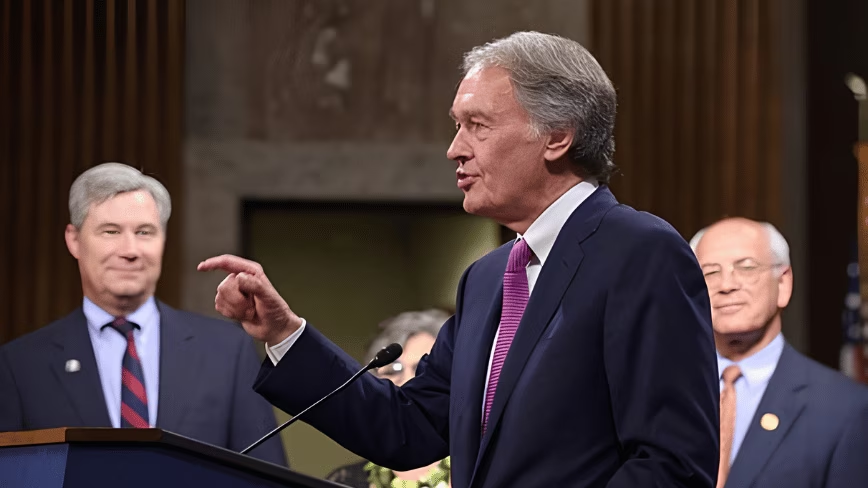
Senator Ed Markey of Massachusetts has introduced a comprehensive package of legislation aimed at reining in the harms of artificial intelligence, with a particular focus on the growing environmental and social impact of data centres. The proposal, unveiled exclusively in an interview with the Guardian, represents the senator's most ambitious attempt yet to create a federal framework for AI accountability.
Markey, a 79-year-old Democrat who has served in the Senate since 2013 and previously in the House of Representatives for 37 years, has long been a vocal critic of unchecked technology. He has authored close to a dozen AI-related bills over the past few years, but this new agenda ties them together under a unified theme: taking power back from big tech and ensuring that AI does not harm the public interest.
The Centrepiece: Data Centre Certification
The cornerstone of the package is a bill that would require any company that owns or plans to build a data centre to obtain certification from the Federal Communications Commission (FCC) before construction can begin. Under the draft legislation, the FCC would assess the proposed data centre's effects on air quality, water quality, noise levels, energy costs, grid reliability, local wildlife, and the local economy. The commission would also consult with the Environmental Protection Agency and local zoning boards before granting approval.
"We need to make sure these data centres don't turn into pollution bombs," Markey said in the interview. The bill responds to a growing number of complaints from communities near data centres, which often require massive amounts of electricity and water for cooling. In rural Georgia, for example, a resident reported that her tap water became undrinkable after a data centre was built nearby—a story Markey frequently cites as evidence of the need for federal oversight.
Addressing Algorithmic Bias and Workplace Surveillance
Beyond data centres, Markey's agenda includes several other key provisions. One bill would require independent bias audits before high-stakes algorithms are deployed in areas like hiring, housing, and credit. The audits would need to be conducted by third-party experts and made public to ensure transparency.
Another bill targets workplace surveillance, barring employers from relying primarily on automated systems to make decisions about hiring, firing, and promotions. This measure directly addresses the case of a veteran nurse who was pressured to trust an AI's judgment over her own, leading to unsafe patient care. Markey's office also cited a woman who sued over an algorithm that she claimed denied her housing, a case that highlights the potential for AI to perpetuate discrimination.
Protecting Children from Emotional Dependence on Chatbots
A particularly poignant part of the agenda focuses on children. One bill would prohibit companies that operate chatbots from allowing children to develop emotional dependence on them. This legislation was inspired by parents who said their 14-year-old son died by suicide after forming a deep emotional bond with a chatbot. The bill would require chatbot makers to implement safeguards that prevent grooming, manipulation, and excessive emotional attachment.
Markey's approach draws on his long history of advocating for children's safety online. In March, the Senate passed a bill tightening online safety rules for children, including banning targeted ads to minors and limiting data collection—a measure that Markey co-sponsored. The new chatbot bill is seen as a natural extension of that work.
Human Oversight in Healthcare Algorithms
The agenda also includes a bill that would require hospitals and healthcare providers to maintain a human override for any AI-driven clinical decisions. The measure responds to growing concerns about the use of AI in diagnostics and treatment planning, particularly when algorithms make errors or when clinicians are pressured to defer to automated recommendations. Markey's bill would ensure that a human physician can always intervene and override an AI's judgment.
The Case for Federal Action
Markey argues that these safeguards should not depend on where a person lives. "Every American is entitled to these safeguards," he said, warning that a state-by-state patchwork "would leave too many people exposed." Currently, AI regulation in the United States is highly fragmented: some states have passed laws on facial recognition or algorithmic bias, but there is no comprehensive federal framework.
This stands in stark contrast to the European Union, which has already enacted the AI Act, a comprehensive regulatory regime that takes a precautionary approach. The EU also has the General Data Protection Regulation (GDPR) and robust online safety rules. Markey's agenda mirrors some of these European principles, particularly the requirement for pre-market approval of high-risk AI systems.
Since the release of ChatGPT in late 2022, Washington has done almost nothing at the federal level to regulate AI, even as Silicon Valley has begun asking for clearer rules. Markey's package seeks to fill that void, but he faces steep political odds. Most of his previous AI bills have stalled in committee, and the current Congress is deeply divided, with Republicans often favoring industry-friendly approaches that prioritize speed over guardrails.
Political Hurdles and Footholds
Markey acknowledges the difficulty but remains optimistic. "Ultimately, there will be national solutions that will be put on the books," he said, pointing to the bipartisan support for the children's online safety bill as evidence that progress is possible. He also noted that other lawmakers are pushing legislation to make Big Tech pay for the rising energy costs driven by data centres, a measure that could gain traction as electricity prices climb and environmental concerns mount.
The senator traces his motivation back to his father, who lost a finger in a factory accident before modern workplace safety laws existed. For Markey, the story illustrates a recurring pattern: technology outruns the rules meant to contain it. AI, he argues, is just the newest version of that gap, and the only way to close it is through proactive federal legislation.
The agenda has drawn praise from consumer advocacy groups and privacy organizations, but it faces stiff opposition from industry lobbyists who argue that overregulation could stifle innovation. Trade groups representing data centre operators have already pushed back, claiming that the FCC certification process would be too cumbersome and could delay much-needed infrastructure projects.
Markey remains undeterred. He plans to formally introduce each bill in the coming weeks, starting with the data centre certification measure. The package is expected to be a key part of the broader debate over AI regulation in the 2024-2025 Congress, especially as the presidential election draws attention to the role of technology in society.
In the meantime, Markey continues to build support by highlighting real-world victims. He has met with the family of the teenager who died after interacting with a chatbot, and with residents of Georgia whose water was contaminated. These stories, he says, are the reason he fights—and the reason he believes that federal action is not just desirable but inevitable.